Monday, February 28, 2011

A new church for Elmira and Horseheads!

A quick note for all.  Fr. Jeff Hoffman reports that last night "we as a body of Christ made it official by  naming ourselves as St. Paul's Anglican Church.  I never imagined we would come  this 
far in this short of a time.   All told we have 20 to 25 people as a part  of our family and we seem to grow each week.  This is an exciting time as we  continue in our journey together.  We must keep
our focus on Jesus and Him  crucified as we each decide how God is calling us to be Church and to do His  bidding.  Please continue to pray for the guidance of the Holy Spirit." 

Beginning Sunday, March 6th, St. Paul's Anglican Church will meet on Sunday evenings.  According to Fr. Hoffman the new church will meet at 4 pm for social time and celebrate Eucharist together at 4:15.  
Eucharist will be followed by dinner,  Adult Bible study and Children Bible study from 5:45 to 7.  For more information, contact Fr. Jeff at  fr.jeffhoffman at yahoo.com  

THIS LOW-BORN CLERIC

Has my gracious lord of Canterbury grown a spine?

Dr Rowan Williams has refused to be drawn on the issue publicly, but has broken his silence to tell MPs he is not prepared for the Coalition to tell the Church how to behave.

He told a private meeting of influential politicians that the Church of England would not bow to public pressure to allow its buildings to be used to conduct same-sex civil partnerships.

The comments are the first time he has spoken since the Coalition unveiled plans to allow religious buildings to be used to conduct homosexual partnership ceremonies.

While the Church has been bitterly divided over the role of its homosexual clergy, he said it held a clear position that marriage is between a man and a woman and would not consider changing this stance.

The tough line taken by the archbishop will frustrate liberals in the Church who have become increasingly disillusioned by his support for a conservative approach to controversial issues.

Some C of E liberals sound like they’re ready to throw in with the Episcopalians.

Although Dr Williams told MPs that the Church of England would not host same-sex unions, other senior clergy, including Lord Harries, the former Bishop of Oxford, and the Dr Jeffrey John, the Dean of St Albans, have said this would represent discrimination.

Giles Fraser, canon chancellor at St Paul’s cathedral, criticised the Church for failing to embrace the steps to greater equality for homosexual couples.

“Gay relationships are perfectly capable of reflecting the love of God,” he said.

“Which is why the church should respond more imaginatively to the idea of same-sex blessings being celebrated in church.”

But Dr. Williams isn’t budging.

Dr Williams’s comments echo the line taken by Dr John Sentamu, the Archbishop of York, who said clergy should not be forced to conduct same-sex civil partnerships.

A Lambeth Palace spokesman said: “The Church still believes on the basis of Bible and tradition that marriage is between a man and a woman and does not accept that this needs to change.”

It’s tough to know what to make of all this. After all, Dr. Williams has no problem at all staying in communion with Anglican provinces who are quite comfortable with marrying homosexuals. So will this matter?

Got me.

Sunday, February 27, 2011

DENVER: Episcopal church's last rites in Englewood fueled by gay divide

DENVER: Episcopal church's last rites in Englewood fueled by gay divide
St. George's will dissolve, the latest in Episcopal exodus

By Electa Draper
The Denver Post
http://www.denverpost.com/ci_13219779#ixzz1F84oRGdW
February 26, 2011


Parishioner Anne Jansson lights a candle in the sanctuary of St. George s Episcopal Church in Englewood. She prayed, she said, for this church one last time. (Craig F. Walker, The Denver Post)

After a farewell service on Sunday, St. George's Episcopal Church will close its doors just short of its 100th anniversary - the latest parish to disintegrate in part because of the ordination of gay and lesbian priests.

The Episcopal Diocese of Colorado will officially deconsecrate the Englewood church, more recently called Holy Apostles, after its short-lived merger with another struggling congregation failed to save it.


Read the full story at www.VirtueOnline.org

Bishop of Jerusalem loses permit to live in Israel

Arieh Cohen writing at Asianews.it reports:

Israel’s Interior Ministry has revoked the permit for the Anglican Bishop in Jerusalem, The Rt Revd Suheil Dawani, to live in Jerusalem, and has refused requests to reinstate it, in spite of protests by Anglican authorities in the West specifically the United States.

The Bishop is a native of the Holy Land and has spent most of his life and ministry here, but cannot obtain either citizenship or legal residence in Israel, since he was born in Nablus, i.e. in the West Bank, which has been under Israeli occupation since 1967, but has not been annexed to Israel. East Jerusalem, on the other hand, where the Anglican Cathedral and Diocesan offices are situated, was also occupied at the same time, but Israel annexed it and considers it part of its national territory (although no other country in the world recognizes this annexation). Therefore, Bishop Dawani is considered by Israel to be a foreigner who can only visit – let alone live in – East Jerusalem with a special permit, which the Israeli authorities can either grant or deny at their sole discretion. In fact, even the original Palestinian inhabitants of East Jerusalem, and their descendants, are considered by Israel to be foreigners who are no more than possessors of a residence permit, which Israel can revoke.

Haaretz.com also says:

The Anglican bishop in Israel, Suheil Dawani, petitioned the Jerusalem District Court yesterday demanding that Interior Minister Eli Yishai return his visa, which was confiscated after it was discovered that he sold land to Palestinians.

Six months ago, Dawani, who has served as the top Anglican official in Israel since 2007, was informed that the Interior Ministry had canceled his visa and that he would be deported from the country....

Last August, the Interior Ministry informed Dawani that it would not renew his visa. In a letter addressed to Dawani, the ministry stated: “[Dawani] acted in concert with the Palestinian Authority by fraudulently selling land owned by Jews to Palestinians − thus being complicit in falsely registering Jewish-owned land as land belong to the church.”

Dawani has denied that he was personally involved in any real estate transactions. “During his tenure, there were no land deals,” said his attorney, Rhanan Har-Zahav. “This is something that is very easy to prove, since there are no documents that would indicate such deals took place.”

“I have written to the attorney general and I asked that before an individual of such stature is deported, we should at least give him the opportunity to present his side,” Har-Zahav said. “Yet even this was not granted to him. Nobody bothered to get back to me.”

...The case has attracted the attention of the Episcopal Church’s bishop in Washington, John Bryson Chane, who protested the Interior Ministry’s decision during a meeting with Israel’s ambassador to Washington, Michael Oren.

Bryson Chane and the presiding bishop of the Episcopal Church in the United States, Katherine Jefferts Schori, wrote a letter to Prime Minister Benjamin Netanyahu urging him to renew Dawani’s visa. A copy of the letter was forwarded to Obama. As of last night, Netanyahu had yet to reply.

“This is a sensitive issue that came before the interior minister and our detailed reply will be given in court as part of the petition that was filed,” the Interior Ministry said in a statement

Asia News continues:

Since the Bishop has of course remained at his post, in Jerusalem, without the permit, he could be arrested at any moment, be put on trial for being in Israel illegally, be sentenced to a prison term – or simply be forcibly removed from Jerusalem.

This situation is causing deep worry to all the Churches in the Holy Land. Because of the representative function of the Churches in the Holy Land, on behalf of the world-wide Christian communities, and because of various personnel needs, a large portion of the bishops, clergy and religious serving in Jerusalem and elsewhere, come from other countries. Israel does not allow them to acquire citizenship or even legal residence, and they can only remain in Israeli territory in virtue of visas that need to be renewed every year or two years – at the Government’s sole discretion. Indeed, as has been made public by news reports over the years, the issue of entry visas and residence for Catholic clergy and religious is a priority item on the agenda of the negotiations between the Holy See and the State of Israel, right from their beginning in 1992 – with no agreement yet. So the predicament of the Anglican Bishop is being watched closely by all the Churches here.

The Bishop has now applied for an Israeli administrative court to intervene, but the prospects for his lawsuit are far from certain. As a matter of general principle, the Government is free to issue or to withhold the kind of permit he needs, without giving detailed reasons, except essentially raisons d’état. There is an opinion, too, that turning to the court is a mistake, since an unfavourable decision by the court (the likelier outcome perhaps) would give the Government the cover of law. It might have been better for him, some say, to rely instead on rousing Western public opinion, in the name of religious freedom and natural justice. Time will tell.

h/t Mad Priest

Via ACNS

Quake toll rises to 147

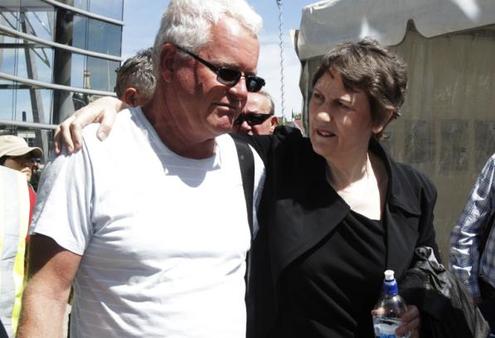
Helen Clark comforts Murray Shaw, deputy chair of New Zealand On Air, in Christchurch. Photo: Chris Hillock,/Waikato Times
A demolition worker cuts up the fallen bell frame at St Mary's in Merivale. Photo: Lloyd Ashton
The tower of St Mary's in Merivale is laid to rest after being badly damaged in the Christchurch quake. Photo: Lloyd Ashton
St Mary's in Merivale, minus half its tower. The adjacent brick vicarage is due for complete demolition. Photo: Lloyd Ashton

The confirmed death toll from the Christchurch earthquake has risen to 147, while the number of missing people ris over 200.

Superintendent Dave Cliff said six bodies had been released to families, while 30 family liaison teams were contacting families both in New Zealand and overseas.

Search and rescue staff completed their initial grid search of the city centre on Friday.

Removal of unstable masonry from ChristChurch Cathedral stopped on Friday evening due to the aftershocks but resumed on Saturday.

Paul Baxter from the New Zealand Fire Service said more than 600 urban search and rescue workers were on the ground, including teams from Australia, Taiwan, Japan, Singapore, the US, Britain and China.

Christchurch Mayor Bob Parker said that of the 1000 buildings within the city's four avenues, just 600 were safe to enter.

Outside the central business district 4600 buildings have been checked, of which 341 are deemed unsafe.

Increasingly, the focus of the emergency operation is shifting to the city's hard-hit eastern suburbs.

A series of aftershocks overnight on Friday caused more damage to buildings in the central city. More than a dozen aftershocks have occurred since 5.40pm on Friday, ranging from 3.0 to 4.4 in magnitude.

Buildings that sustained further damage included the old Girls' High building on Park Terrace, St Elmo's Court in Hereford St, and Knox Church on Bealey Avenue.

Slow progress in cathedral

Recovery teams are making progress on painstaking work to remove bodies from the iconic cathedral labelled the "broken heart" of Christchurch.

Police believe up to 22 bodies remain inside ChristChurch Cathedral and its spire.

Fire Service spokesman Paul Baxter said the operation had been hampered by the continual aftershocks.

However, more heavy machinery has since been brought in.

Engineers have braced the west wall at the site and are removing loose and insecure masonry.

Two cranes are being used for the work, which engineers say is delicate and difficult.

Among the engineers was Ian Oliver from New Plymouth who was with a team on a raised platform assessing the damage.

"It's slow but it has to be, the whole thing could just go at any time."

He said the inside of the spire had a stack of rubble that was about 30 metres high.

The spire's bells, each weighing at least a tonne, would have been destroyed after the roof caved in.

He was not sure when the urban search and rescue teams would go in.

"It's just a mess, it's just all rubble inside ... you should see the inside of the cathedral though, it's like a bomb has gone off in there."

'Graceful removal'

Dean Peter Beck has asked the teams to do all they can to ensure the "graceful removal" of the bodies.

"They are working in the broken heart of Christchurch. That's why we are concerned that such great care is taken with this bodies being recovered."

He believed they would begin their search for the dead "within days, not weeks".

Though he has no idea of how many people were in the spire or the cathedral at the time the quake struck, he believes that most of them were probably overseas tourists.

His staff are planning a prayer service once the bodies are found.

"The whole enormity of it all still hasn't hit me but I think I am due for a bloody good cry."

Christchurch Mayor Bob Parker said the cathedral would be rebuilt as it was "strong and symbolic".

"There is some discussion that that is a building we could rebuild brick by brick, stone by stone. We need to find some symbols like that."

Dean Beck said a preliminary report from the church's structural engineer showed that significant parts of the cathedral could be saved.

He said the job was necessary for Christchurch, as the cathedral was a symbol of city's resilience.

A memorial to those lost inside the cathedral would be erected when it is one day rebuilt, he added.

"Rebuilding the cathedral is symbolic of rebuilding the city - it's spirit. It is a symbolic representation of the whole city.

"Of course there will always be a sense of loss. We will always carry that with us. It will become part of us. But we will be strong and resilient again."

The assessment team includes the engineer who oversaw the cathedral's original earthquake strengthening.

Dean Beck told TV3 that talk of a special service was "a bit soon".

About 26 Anglican churches were in "a very bad way," he said.

HOUSTON:Unable to pay millions needed for repairs, Episcopal Church will close

HOUSTON: Unable to pay millions needed for repairs, East End Episcopal Church will open doors for last time
Joyful noise is going silent

By KATE SHELLNUTT
HOUSTON CHRONICLE
Feb. 25, 2011

Ministry of Dance members practice their worship presentation in the sanctuary of the Church of the Redeemer. In the background is the historic East End Episcopal church's famed mural, called Christ of the Workingman.

As much as Church of the Redeemer's members will miss the glowing mural of the risen Christ, the sanctuary echoing with music, the basement lined with old photos and the historic buildings themselves, they're most heartbroken to leave the place where they served the Eastwood neighborhood for more than 90 years.

Redeemer can't afford the $7 million needed to bring the church up to code, so after Sunday's service, the congregation will move from its crumbling structure to a shared space in a nearby Lutheran church, where a group of small-but-committed parishioners will try to keep up with its outreach programs.

Read the full story at www.VirtueOnline.org

Saturday, February 26, 2011

Armstrong sentenced to probation, $99,247 restitution

THE GAZETTE

A judge Friday sentenced the Rev. Donald Armstrong to four years probation for his no-contest plea to one count of misdemeanor theft of funds from the Colorado Springs church where he once served as rector.

Fourth Judicial District Judge Gregory R. Werner also ordered Armstrong to pay restitution in the amount of $99,247 that was diverted to pay for his son's and daughter’s college education. The money came from a trust fund originally set up to pay for the education of seminary students.

But Werner rejected a request by a special prosecutor to order Armstrong to repay Grace and St. Stephen’s Episcopal Church an additional $191,753 in church funds that also were spent on his children’s education.

Werner cited testimony by three former church officials who testified they knew of a deal where the church paid the tuition in lieu of giving Armstrong a raise for several years.

The judge also ordered Armstrong to perform 400 hours of community service not related to his current church and forbade him from managing the funds of any trust, business or legal entity.

Armstrong’s probation will run concurrent with a four-year deferred sentence he received in September when he also entered a no-contest plea to one count of felony theft. Unlike the misdemeanor, however, that will not become part of his permanent record if he does not break the law during that period.

While the sentence imposed Friday was less than what several members of the congregation had sought, several of them expressed relief they had reached the end of a series of legal battles that occurred when the allegations of misuse of funds first surfaced in 2006.

As a result of those allegations, the Episcopal Diocese of Colorado defrocked Armstrong. In March 2007 he started a new church. Many members of his old congregation now attend that church, St. George’s Anglican. A protracted legal battle over church property followed, with the courts ultimately ruling in favor of Grace Church.

“I’m very thankful for myself and the parish that it’s over,” said Elizabeth Lilly, a member of the Grace Church congregation. “It’s been a long four years.”

Prosecutors had asked the judge to consider jail time for Armstrong, without saying how much.

“I’m sure if church members had their way they would lock him up and send him to Elba,” said Pueblo County Deputy District Attorney Stephen Jones, alluding to the island near Italy where Napoleon was exiled.

Jones served as special prosecutor in the case because former El Paso County District Attorney John Newsome had been a member of the vestry, or governing body, at Grace Church.

Jones also asked the judge to order Armstrong to write a public apology to his former congregation, noting remarks Armstrong made after entering the no-contest plea in which he continued to maintain his innocence.

“It seems like there’s been no acceptance on the part of Mr. Armstrong to the reality of what he did,” Jones said.

But Armstrong’s lawyer, Dennis Hartley, told the judge that sending the priest to jail would only make him a hero in the eyes of his current parish.

“It will just deepen the hurt that’s the product of these lawsuits,” Hartley said, referring to the legal battles between the two churches.

Hartley also said he chose not to bring in a string of witnesses from St. George’s to testify at the sentencing because “we didn’t see anything to gain by getting into a game of who got hurt the most.”

Unlike Armstrong’s remarks after his plea, Hartley said this time his client had no comment.

Werner refused to order an apology, citing his practice of not wanting to get involved in how such a letter would be worded. He also agreed with Hartley that jail time would serve no purpose.

“There is a huge divide between these two churches,” he added.


Read more: http://www.gazette.com/articles/rev-113541-donald-sentenced.html#ixzz1F47XwXU8

Hat tip: Fr. Dick Kim

Friday, February 25, 2011

Rushing to Judgment: a Spurious Defense of Title IV (Pt. II)

[Note: Part I of this analysis of the justifications offered for the new disciplinary canons ("Title IV") approved by General Convention 2009 may be read at this link.]

The paper published by the Title IV "Task Force II" takes up three constitutional challenges to the 2009 revisions approved for Title IV of the national Canons (dealing with the discipline of clergy). The first challenge is that the revisions are in derogation of the powers reserved to the Dioceses in Article IX of the Constitution, which provides in part: " . . . Presbyters and Deacons canonically resident in a Diocese shall be tried by a Court instituted by the Convention thereof . . ." (italics added). (The other two challenges will be addressed in subsequent posts.)

The paper answers this challenge by contending that the current language of Article IX reserves to the Dioceses literally only the power to create the courts to try priests and deacons. General Convention, on the other hand, is free (under the authors' view) to specify in detail just which kinds of persons, and how many of each, will serve on the courts; their specific jurisdiction over clerical offenses; the procedures to be followed in bringing charges, working out a consent order, referring a case for hearing, conducting a trial, and pronouncing or modifying judgment. In other words, the dioceses create only the skeleton, and supply the personnel; it is General Convention which has the power to flesh everything out and make the whole system work.

Such an argument appears dubious on its face to anyone versed in the law: the power to establish courts normally goes hand in hand with specifying their jurisdiction, staffing, and procedures. And that, indeed, is the way ECUSA did things until very recently. But according to the authors of the Task Force II paper, a little-noticed change made in the wording of Article IX approved in 1901 made all the difference in the world.

The change had come as a very minor element in the comprehensive overhaul of the entire Constitution which lasted from 1889 to 1901 -- through five successive General Conventions. (See the series of posts under the heading "Constitutional Changes" at this link for a detailed history of that process.) From 1841 to 1901, the clause in question had read: "In every Diocese, the mode of trying Presbyters and Deacons shall be instituted by the Convention of the Church therein . . .", and virtually the same wording was in Article VI of the original constitution adopted in 1789.

It is the argument of the paper that the 1901 shift in emphasis from Dioceses "instituting the mode of trying" priests and deacons to Dioceses "constituting the courts" to try them "profoundly changed" the balance of power between the Dioceses and General Convention:
The wording adopted in 1901, however, profoundly changed this Constitutional scheme. Instead of reserving to the several Dioceses the “mode” ‐ the full range ‐ of disciplinary activities, it very precisely prescribed that which is left to the Dioceses: the “institution” of the “Court” by which Priests or Deacons may be tried. No longer do the Dioceses have exclusive rights with respect to the full range of disciplinary activities; from and after 1901, the only part of those activities exclusively reserved to the Dioceses is the establishment of the Court before which trial, if there is to be one, is to be conducted. As a result of this change, General Convention is now constitutionally free to legislate in the area of clergy discipline.
This argument not only ignores the historical context of the 1901 revisions to the Constitution, but it also way overstates its case. The issue has never been whether "General Convention was free to legislate in the area of clergy discipline" -- it has done so ever since the original Convention of the Church in 1789. Canon XII adopted by that first gathering dealt with "Notorious Crimes and Scandals to be censured", and referred to "such rules or process as may be provided, either by the General Convention or by the Conventions in the different States." (1789 Journal [ed. W.S. Perry 1874], Appendix, at p. 128; italics added.) The same language was enacted in Canon XIII ("Sober conversation required in Ministers"), which provided for "the ecclesiastical censure of admonition, or suspension, or degradation [of any 'ecclesiastical person'], as the nature of the case may require, and according to such rules or process as may be provided, either by General Convention or by the Conventions in the different States."

Over time, and with the enactment of subsequent canons, the division of powers envisioned by the founders became clearer: to General Convention was reserved the power of legislating for the discipline of bishops (using a court formed under the House of Bishops), while the individual Dioceses kept control of disciplinary proceedings with respect to priests and deacons canonically resident within their boundaries. For example, the second canon enacted in 1792 specified that the presentment and trial of clergy committing offenses in dioceses other than where they were resident would be the responsibility of the ecclesiastical authority of the diocese "to which such offender belongs . . .".

But when it came to the specification of offenses for which members of the clergy could be tried, both the General Convention and the several Dioceses exercised a form of concurrent jurisdiction. That is, General Convention enacted various canons (as just noted, beginning in 1789) to define the conduct which made any member of the clergy subject to presentment and trial. The Dioceses, however, were not bound by those definitions, and were recognized as having the authority to add to them, as Edward A. White explained in his original annotated edition of the Constitution and Canons in 1924 (pp. 566-67):
This Canon [Canon 28, the successor to original Canon XIII of 1789] declares that a Bishop, Priest, or Deacon shall be liable to presentment and trial for the offences [sic] named in the Canon; can this list of offences be added to by a Diocesan Convention, or can a Minister be presented and tried for an offence not enumerated in the Canon?

. . .
In the trial of the Rev. Mr. Trapnall, in Maryland, in 1847, objection was made to the presentment, which was framed under a Canon of the Diocese of Maryland, said Canon enumerating under other canonical offences, conduct incompatible with the character of a minister of Christ, that such presentment was void because it constituted a new triable offence, one not named in the Canons of General Convention. This objection was overruled by the Court, and a part of the argument of the Church Advocate was, that the Canon of the General Convention did not contain the full penal code of the Church -- that its title was "Of Offences for which a Clergyman may be tried," not of "theOffences." That the General Convention only meant to specify certain offences for which a Clergyman must be tried, leaving the code to be filled up as separate Diocesan Conventions might deem proper. In other words, that the legislation of the General Convention was not designed to be exclusive legislation.
In their response to the Task Force paper, Messrs. Runyan and McCall have given additional proofs from history to show why the change to the language of Article IX in 1901 did not effect a substantive change in the division of exclusive jurisdiction between the Dioceses and General Convention which had theretofore been uniformly observed. One of the proposals made in 1895 by the Joint Commission on the Revision of the Constitution and Canons was to give General Convention "exclusive power to enact Canons defining the offenses for which Bishops, Presbyters and Deacons may be tried, and determining the penalties . . ." Like its other proposals to give General Convention supreme legislative powers in certain areas, however, this idea was thoroughly repudiated when the dioceses assembled in General Convention in Washington, D.C. in 1898.

Given this historical background, as Messrs. Runyan and McCall point out, there is no warrant for arguing that the change finally made to the wording of Article IX in 1901 was intended as a major change in course with regard to the powers of General Convention. If anything, the revisions approved in 1901 were settled upon only after the radical proposals to expand those powers had gone down to a stinging defeat.

The most telling evidence that no substantive change was effected in 1901, however, is the evidence pertaining to the extreme difficulty encountered in establishing appellate courts (Courts of Review) with the power to affirm, reverse or modify the decisions of diocesan tribunals. Once again, Edward White provides the definitive history (pp. 620-21; see also White & Dykman [1981], Vol. II, pp. 989-991):
The question of providing Appellate Courts has occupied the attention of a majority of the General Conventions since 1853. In the General Convention of that year, an amendment to the then sixth Article of the Constitution was approved by both Houses, inserting the words "until the General Convention shall provide a uniform mode of trial," after the words "In every Diocese the mode of trying Presbyters and Deacons may be instituted by the Convention of the Diocese."
. . .
The Convention of 1856 defeated the amendment to the Constitution adopted by the Convention of 1853, through failure of the Laity to concur therein. The Convention, however, approved of an amendment to the said sixth Article of the Constitution in another form, substituting for the words of the former proposed amendment the following: "but the General Convention may establish a Court of Appeals for the revision of Diocesan Courts," and also adding at the end of the Article the words: "Such Court of Appeals not to revise the determination of any question of fact."
. . .
The proposed amendment to Article VI. of the Constitution approved by the Convention of 1856 was defeated in both Houses of the Convention of 1859. So decisive was the defeat of the attempt to amend the Constitution to provide for a Court of Appeals, that the question was not again seriously brought before General Convention until 1871. From that time until the revision of the Constitution in 1901, when the amendment to the Constitution was finally enacted, providing that the General Convention might establish Courts of Review and an Ultimate Court of Appeal, the question was presented to almost every General Convention. . . .
Mr. White also notes that earlier proposals to establish Courts of Review by the adoption of a suitable Canon were all defeated by the argument that such a Canon could not properly be enacted without an amendment first being made to the Constitution. In 1904, after the Constitution had been successfully amended, General Convention enacted its first Canon to establish the desired Courts of Review. A proposal to establish an Ultimate Court of Review, however, went down to defeat after being considered by several subsequent Conventions.

If the argument in the Task Force II paper were correct, General Convention would have had the power -- without needing any authority in the Constitution -- to establish a Court of Review even before the Constitution was amended in 1901 to authorize such a Canon. That is because they argue the Constitution's silence on the power to legislate about clergy discipline after 1901 left the field open for General Convention to occupy. But the Constitution was similarly silent before 1901 on the subject of reviewing judgments from the diocesan tribunals, so if its silence constituted authority to legislate, then nothing stood in the way of General Convention's authority to create such courts of review. (And that, indeed, was the view of a number of canon lawyers in General Convention before 1901, but they remained in the minority.) Thus, every single proposal to that effect before 1901 -- and there were many -- was rejected.

Thus, the justification offered by the "Task Force II" on Title IV has no historical basis in fact, and constitutes a misreading of the intent of those who enacted the language. And as argued at the outset of this post, there is no rational basis for dividing the power to establish courts from the power to define their jurisdiction, constitution, and procedures. Read in that way, Article IX becomes a mere fig leaf: the real power to create the courts, notwithstanding the language of Article IX, lies in General Convention.

And so to read Article IX, in a paper submitted by the authors of the revisions to Title IV, is to express everything that is wrong with the current views of the leadership of ECUSA as to its polity. In the state court lawsuits, over and over again, that leadership has beat the drum for ECUSA's "hierarchical" polity, when -- as shown in the first post in this series -- there is no such hierarchy as between the dioceses themselves, or when assembled in General Convention. The proof of this point lies in the latest revisions to Title IV themselves. On the"Publications" page of General Convention may be found links to various documents regarding the revisions, including a set of "model" canons for the dioceses to enact in order to implement the revisions.

Without the dioceses enacting those (or similar canons) in their own separate conventions, the changes to Title IV approved at the national level in 2009 could never take effect. They would remain as airy abstractions, incapable of being translated to actions on the ground. The very fact that the Dioceses are necessary to give concrete fulfillment to the enactments of General Convention is proof enough, if any more were needed, that to speak of the "powers" of General Convention to enact canons "binding" on the separate Dioceses is utter and ignorant nonsense.

SAN DIEGO: St. Mary's Episcopal Church to Close Sunday After More Than 50 Years

SAN DIEGO DIOCESE: St. Mary's Episcopal Church to Close Sunday After More Than 50 Years

http://imperialbeach.patch.com/
February 23,2011

IMPERIAL BEACH, CA---After first opening its doors in 1960, St. Mary's Episcopal Church will hold its last services Sunday.

The Episcopal Diocese of San Diego, who have supported the church financially for decades, said they can no longer afford to do so.

About 10 to 15 families regularly attend, said Rev. Peter Tagdulang, who served as the church's leader since March 2009.

"Their hearts are bleeding right now with the closure," Tagulang said. "It's a very sad thing."

Each week the church held healing services on Thursdays and English and Spanish services on Sundays.

Read the full story at www.VirtueOnline.or

Will pecusa add F to GLBTI?

HOT AND BOTHERED

Don’t look now but there may be a brand new group for Episcopalians to kiss up to:

Ever since Madonna planted that wet kiss on Britney Spears in front of millions of television viewers at the 2003 MTV Video Music Awards, women have been loosening up sexually with other women.

These so-called flexisexuals say that although they are not gay or even bisexual, they enjoy flirting and kissing girls — but they still enjoy having sex with men.

Experts say they may be influenced by the growing visibility of same-sex couples and more open attitudes about sex in general.

Flexisexual is also known as heteroflexible, pansexual or queer, all subtle variations that mean they are not closing any doors.

Let’s see. Jesus never said anything about it, Scripture writers didn’t know what we know now, Jesus never turned anyone away, all-inclusive love of God, etc. Yeah, it might work and it’s worth a shot. Vague, Ambiguous Deity Concept knows, TEO’s homosexual fling has been a financial disaster.

Dr. Robert Gagnon demolishes the David and Jonathan “love affair” myth

I love the way Dr. Gagnon effortlessly dismisses the silly myth-making of the Anglican Left. Here he takes on one of the favorite and more absurd assertions of those advocating sex acts between people of the same sex
David and Jonathan
Miller cites the relationship of David and Jonathan as an example of the “enduring love between men,” adding: “What Jonathan and David did or did not do in privacy is perhaps best left to history and our own imaginations.” That is tantamount to saying, “What Ruth and her mother-in-law Naomi did in the bedroom is best left to our own imaginations,” as if the Bible could possibly be condoning a case of incest; or even tantamount to saying that whether Jesus’ saying about “let the little children come to me” had any positive implications for sex with children is “best left to our imaginations.” When the text of Scripture understood in its literary and historical contexts gives little or no basis for “our own imaginations” to conjure up sexual activity, it is irresponsible to grant or take imaginative license. Such is the case with the relationship of David and Jonathan.

Homosexualist interpretations of David and Jonathan mistake non-erotic covenant/kinship language for erotic intimacy. For example:

The statement that “the soul of Jonathan was bound to the soul of David, and Jonathan loved him as his own soul” (1 Samuel 18:1) can be compared to the non-erotic kinship language in Genesis 44:31 (“[Jacob’s] soul is bound up with [his son Benjamin’s] soul”) and Leviticus 19:18 (“You shall love your neighbor as yourself”). It can also be compared to formulaic treaty language in the ancient Near East, such as the address of the Assyrian king Ashurbanipal to his vassals (“You must love [me] as yourselves”) and the reference in 1 Kings 5:1 to King Hiram of Tyre as David’s “lover.”

Similarly, the remark in 1 Samuel 19:1 that Jonathan “delighted very much” in David can be compared to the non-erotic references in 1 Samuel 18:22 (“The king [Saul] is delighted with you [David], and all his servants love you; now then, become the king’s son-in-law”) and 2 Samuel 20:11 (“Whoever delights in Joab, and whoever is for David, [let him follow] after Joab”).

When David had to flee from Saul, David and Jonathan had a farewell meeting, in which David “bowed three times [to Jonathan], and they kissed each other, and wept with each other” (1 Sam 20:41-42). The bowing suggests political, rather than sexual, overtones. As for the kissing, only three out of twenty-seven occurrences of the Hebrew verb “to kiss” have an erotic dimension; most refer to kissing between father and son or between brothers.

In 1 Samuel 20:30-34, Saul screams at Jonathan: “You son of a perverse, rebellious woman! Do I not know that you have chosen the son of Jesse [David] to your own shame and to the shame of your mother’s nakedness?” Here Saul is not accusing his son of playing the passive-receptive role in man-male intercourse with David (cf. 2 Sam 19:5-6). Rather, he charges Jonathan with bringing shame on the mother who bore him by acquiescing to David’s claim on Saul’s throne.

When David learns of the deaths of Saul and Jonathan he states of Jonathan “you were very dear to me; your love to me was more wonderful to me than the love of women” (2 Sam 1:26). The Hebrew verb for “were very dear to” is used in a sexual sense in the Old Testament only two out of twenty-six occurrences and a related form is used just three verses earlier when David refers to Saul as “lovely,” obviously in a non-erotic sense. Jonathan’s giving up his place as royal heir and risking his life for David surpassed anything David had known from a committed erotic relationship with a woman; but there was nothing sexual in the act. As Proverbs 18:24 notes (in a non-sexual context): “There is a lover/friend who sticks closer than a brother.”

The narrator’s (narrators’) willingness to speak of David’s vigorous heterosexual life (compare the relationship with Bathsheba) puts in stark relief his (their) complete silence about any sexual activity between David and Jonathan. Put simply, homosexualist interpretations of the relationship between David and Jonathan misunderstand the political overtones of the Succession Narrative in 1 Samuel 16:14 – 2 Samuel 5:10. Jonathan’s handing over his robe, armor, sword, bow, and belt were acts of political investiture, transferring the office of heir apparent to David (1 Samuel 18:4). The point of emphasizing the close relationship between David and Jonathan was to stress the view that David was not a rogue usurper to Saul’s throne. Rather, he was adopted by Jonathan into his father’s “house” (family, dynasty) as though he were Jonathan’s older brother. Neither the narrator(s) of the Succession Narrative nor the author(s) of the Deuteronomistic History show any concern about homosexual scandal, because, in the context of ancient Near Eastern conventions, nothing in the narrative raised suspicions about a homosexual relationship. (For further discussion, see Gagnon, The Bible and Homosexual Practice, 146-54; Markus Zehnder,“Observations on the Relationship between David and Jonathan and the Debate on Homosexuality,” Westminster Theological Journal 69.1 [2007]: 127-74)...more
The entire article is brilliant, so please take the time to study it.

(First Things) Douglas Farrow—Blurring Sexual Boundaries

The proposed addition of “gender identity and expression” carries that transformation even further by suppressing the binary logic itself. Backers of these bills often make no attempt to disguise this. “One of the great myths of our culture,” insists the Canadian Labor Congress, “is that at birth each infant can be identified as distinctly ‘male’ or ‘female’ (biological sex), will grow up to have correspondingly ‘masculine’ or ‘feminine’ behavior (public gender), live as a ‘man’ or a ‘woman’ (social gender role), and marry a woman or a man (heterosexual affective orientation). This is not so.”

The standard notion of sex, then, must be replaced by the more malleable concepts of sexual orientation and gender identity. And I do mean must. Here in Quebec a recent government white paper promises to wipe society clean of both homophobia and heterosexism—that is, of any “affirmation of heterosexuality as a social norm or the highest form of sexual orientation [and of any] social practice that conceals the diversity of sexual orientations and identities.”

What this will mean in the long run for the legal protection of women remains to be seen, of course, but we can’t have it both ways. Sex cannot serve as an effective legal marker for discrimination if its binary nature dissolves into fluid sexual subjectivities. In that sense, these bills constitute unfriendly amendments to the civil and criminal codes they purport to refine or perfect.

Read it all.

Thursday, February 24, 2011

From VirtueOnline

Posted by David Virtue on 2011/2/24 13:20:00 (171 reads)

Critics and Framers Go Head to Head over Constitutionality of Disciplinary Canon Revisions

News Analysis

By David W. Virtue
www.virtueonline.org
February 24, 2011

A constitutional battle has broken out in The Episcopal Church between those who believe the revised Title IV canons are constitutional and those who believe they are not. Naysayers say they will give the Presiding Bishop unprecedented powers she has no right to have.

What it means is this: come July 1 and the newly revised Title IV canons are in place, Presiding Bishop Jefferts Schori will be able to wield the stick of inhibition and deposition dangled with the carrot of conformity to a largely acquiescent and fawning House of Bishops. It will mean that she can interfere in the life of dioceses like South Carolina and Central Florida with impunity if she believes they are not in conformity to the church's national canons.

Conservative canon lawyer Allan S. Haley says that ECUSA is barely four months away from precipitating a wholly unnecessary constitutional crisis that can only weaken it further and drive its constituent pieces yet further apart. He says the changes to Title IV will transform the Presiding Bishop of ECUSA into a metropolitan.

An article written by C. Alan Runyan, a South Carolina lawyer, and Mark McCall, a member of the New York bar for the Anglican Communion Institute (a group of serious-minded Episcopalian theologians bent on staying in The Episcopal Church), entitled "Title IV Revisions Unmasked," blasted the changes arguing that the new Title IV disciplinary canons enacted at the last General Convention are unconstitutional and unwise. They are unconstitutional because they infringe on the exclusive rights of dioceses to institute courts for the discipline of clergy and give the Presiding Bishop metropolitical authority over other bishops. They are unwise because they deny basic due process rights to diocesan clergy.

Opponents to the Title IV revisions also object to provisions in the sections pertaining to discipline of bishops that give the presiding bishop the ability to give pastoral direction to other bishops and the ability to temporarily inhibit a bishop without the consent of the Standing Committee of the diocese in which he or she has jurisdiction. They argue that the presiding bishop's duties and authority are limited by the constitution.

Constitutional language prohibits a bishop from exercising their authority outside of the diocese that elected them. With the pending changes, that authority now applies to the presiding bishop, in their opinion.

Three supporters of the changes to the "Title IV Task Force II Framers" have defended the constitutionality of the disciplinary canon revisions. Duncan Bayne, Diocese of Olympia vice chancellor; Stephen Hutchinson, Diocese of Utah chancellor; and Joseph Delafield, Diocese of Maine chancellor say that all three were "active participants in the nine-year process of development and adoption of the amendments."

They have hit back at the ACI theologians who say the disciplinary canons set to go into effect July 1 are unconstitutional by asserting the constitutionality of the amendments.

Delafield said in his short statement that the three wrote the paper in response to questions that were raised by the leadership of the Diocese of South Carolina and others as to whether the revision conforms to the church's constitution.

Defenders of the Title IV revisions say that the church's constitution authorizes the canons to spell out the presiding bishop's duties while opponents say that the presiding bishop's duties and authority are limited by the constitution.

Bishop Mark Lawrence of South Carolina does not believe that General Convention has that authority. His Diocesan Convention has backed him up by refusing to accede to the new Title IV revisions adopted at Anaheim in 2009.

During its Feb. 18 - 19 220th annual convention, the Diocese of South Carolina "passed again" two of the "protective resolutions" that a re-convened diocesan convention had approved in October.

The first resolution removed the accession clause to the Canons of the Episcopal Church. The second enabled the convention to meet more frequently than annually, if needed.

"These resolutions seek to protect the diocese from any attempt at un-constitutional intrusions in our corporate life in South Carolina and were in response to the revisions to the Title IV Canons of the Episcopal Church," the diocese argues.

In his convention address, Lawrence argued that the actions he has taken in recent months concerning his stand on the revisions include talking to his fellow provincial bishops and hearing their concerns, as well as speaking at the clergy conference in the Diocese of Central Pennsylvania.

"Certainly there remain, however, significant differences for many of us with the direction of the Episcopal Church," Lawrence told the convention before the vote on the resolutions. "So I believe we need to finish what we set out to do at our convention in 2010, upholding the heritage and constitution of our church. I believe we have done a service to everyone in the Episcopal Church by pointing out the problems inherent in the Title IV revisions."

The diocese voted overwhelmingly by a two-thirds majority not to cede authority to the national church, but to retain their sovereign right. They will no longer recognize the Canons of the national Church as binding in the Diocese, to the extent that they are inconsistent with the diocesan Constitution and Canons. The Diocese of Central Florida recently said its canons would comply with those of the Episcopal Church as long as they did not violate the church's constitution in a vote related to the Title IV revisions. After tabling a vote on the revisions during their October convention, Dallas Episcopalians are due to consider the revisions during a special convention this year. The Diocese of Western Louisiana said during its last convention that the General Convention of the Episcopal Church ought to change the Title IV revisions to limit the authority given to the presiding bishop.

Haley argues that the changes to Title IV are voluntary -- that is, it is up to each diocese to decide whether to accept or reject them. A confederation is based on a contract among its members. The contract is renewed every time the members agree upon something in accordance with their governing rules. As is the case with every contract, changes to it need the consent of all parties. Since the governing agreements do not include a Supremacy Clause, the result is that a party who does not consent to a change cannot be bound by it.

"If a diocese elects not to adopt the Title IV revisions, there is nothing that General Convention, or the Presiding Bishop, or the staff at 815 Second Avenue, can do about it. The changes to Title IV will simply have no effect in that particular diocese. Again, this is a consequence of two factors: ECUSA's Constitution has no Supremacy Clause, and ECUSA has never established a constitutional court with final authority to interpret the Constitution."

Haley further argues that to speak of the "constitutionality" or "unconstitutionality" of the changes as a whole distorts the real picture. "The changes may indeed be 'unconstitutional', from any particular diocese's standpoint -- but it is up to each individual diocese to make that decision. And in doing so, that particular diocese is SOVEREIGN -- there is no authority within ECUSA that can force it to accept the changes against its will, or override its decision not to accept them.

"I regard the fact that the eight-page memorandum from the Title IV Task Force II nowhere acknowledges these basic principles as a fundamental, and fatal, flaw in its overall reasoning. The memorandum, indeed, proceeds from a point of view, which holds that whatever its authors and the staff at 815 decide that General Convention approved in 2009, is thereby ipso facto 'final' and 'binding' on the collective dioceses. (See the Fourth Proposition above for a refutation of this view.)

"Unless and until the truth of the foregoing four propositions is recognized, there can be no real common ground in discussing the propriety of the changes made to Title IV. Those on the left, like the Title IV Task Forces I and II, will think that they are justified in proceeding under the new canons to discipline and sanction those clergy who disagree with them. But those who disagree must take heart in the undeniable facts about how ECUSA came into being, and what exactly is the consequent authority of General Convention.

"The moment a diocesan bishop rejects the Directive as being unconstitutional, there will be a confrontation in which one party -- either the Presiding Bishop or the bishop of the diocese -- will have to back down. If the Presiding Bishop proceeds to exercise her new disciplinary powers, leading to her signing a certificate of inhibition, and then asking the House of Bishops to depose the recalcitrant bishop, civil war could erupt in the halls of the Church", writes Haley.

"We could end up with a further splintering of factions -- with two persons claiming authority to act as the bishop of a given diocese (one of them installed 'provisionally' by the Presiding Bishop and the other contending that s/he had not been legitimately deposed)."

Alternatively, a diocese could vote itself to pull out of The Episcopal Church with consequences similar to those of the four dioceses which have already withdrawn from TEC.

One wonders how long the HOB will tolerate seeing their numbers decrease while inhibitions and depositions increase and continuing litigation slowly empties the church's coffers as budgets are trimmed and the church's governance and structures prove inadequate in the 21st Century.

The die has been cast.

END