Friday, March 09, 2012


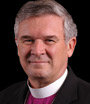
 Message from Bishop David Anderson 
Bishop Anderson
Bishop Anderson


Dear Brothers and Sisters in Christ Jesus,

The other day a friend took me to lunch in downtown Atlanta at a small, funky restaurant that I never knew existed. The food was very good, but what struck me in particular was a picture on the wall of Leonardo DaVinci's "The Last Supper." Superimposed on the picture were cartoon balloons with conversation in each. One balloon was attached to an apostle on one end of the table, calling out to an unseen waiter, "Separate checks, please!"  The second balloon was attached to Jesus, who was saying, "That's OK, I'll be paying the price for all of you."
Last Supper II

Clearly this little restaurant has a very low key, subtle ministry of evangelism to a crowd that might never hear the Gospel in a church setting - yet while sitting there eating a pulled pork sandwich, one might begin to notice that there is "folk art" spaced out on the walls, conveying a distinct message in a refreshingly new way. It gave me something to think about as we continue in our passage through the Lenten season of introspection and repentance.

The troubles in Nigeria with the radical Islamist group Boko Haram continue, with the group announcing their intent to eradicate Christianity in Nigeria. Beginning in Northern Nigeria, they plan on launching further attacks targeting Christians. They seem to have adequate small arms to bring terror and bloodshed to Christian families and burn Christian churches, all while the army and the police do next to nothing. In fact, the army and police are also frequent targets of Boko Haram's attacks themselves. The question is, why don't the Christians have any means of their own to protect themselves?  Although in Europe and Great Britain the general population is prohibited from having firearms to protect themselves, in the United States the 2nd Amendment of the Constitution guarantees law-abiding citizens such a right. When the police are slow to respond to a violent home invasion, many times the home owner has been able to defend himself with his own firearm, but apparently such is not the case in Nigeria. To be able to adequately defend one's home and hearth seems to me to be a more vital human right than some other more recently discovered rights.
I have learned the hard way never to say, "It can't get worse," because it always can, no matter how bad it already is. As Albert Mohler says in the article included below, "The debate over abortion comes down to one essential issue - the moral status of the unborn child." One argument that those of us who are pro-life have used is the early date in the womb that the fetal child can feel pain to establish that a living, feeling child is present. Those who favor a mother's right to kill her unborn child are suggesting that a higher standard needs to be used, arguing that such a child lacks the ability to anticipate the future and to communicate. A justification for killing unwanted children is now being proposed not only for children in the womb, but for newborns and possibly older children as well. Alberto Giubilini of the University of Milan and Francesca Minerva of the University of Melbourne and Oxford University are arguing for the legal killing of children after they have been born and are viable. They are trying to characterize it as "after-birth abortion," since it doesn't sound as bad even to them as the correct term, "infanticide."

A problem with their definition of personhood based on the ability to 'anticipate the future' and 'communicate' is that this ability develops over the first years of a child's life. A baby's crying, which is a form of communication, gives way to head shaking and "no" as one of the first words after "mama" and "daddy." So when does the child anticipate the future? It probably depends on the child, but does that mean that we should be able to kill them up until the time when they can? Even our pets are able to use their voice to communicate in a simple manner, and they can anticipate the future quite well. What dog or cat doesn't recognize the sound of an electric can opener, and, anticipating a meal, makes a beeline to the kitchen?

Giubilini and Minerva reflect a godless, anti-life sentiment that must be stopped. I won't call them secular humanists, because their point of view is so anti-human that they need their own category within the culture of death. They are called medical ethicists, but neither word really applies. There is nothing medical in murder, and nothing ethical in their advocacy, even though the Journal of Medical Ethics has published their article. May God have mercy on the children, and inspire us to be their defenders.

Blessings and Peace in Jesus,

+David

The Rt. Rev. David C. Anderson, Sr.
President and CEO, American Anglican Council

No comments: