Thursday, February 28, 2013

Liberals unable to get their way in the UMC


Talk Grows of Liberal Exodus from UMC

Talk Grows of Liberal Exodus from UMC

By John Lomperis
http://juicyecumenism.com/2013/02/27/talk-grows-of-liberal-exodus-from-umc/
February 23, 2013

Since last spring's General Conference, there has been an unprecedented mushrooming of talk of liberal exodus from the United Methodist Church. For all of the surrounding frustration, that landmark event in Tampa, Florida was an apparent turning point in the struggle for the soul of our global denomination.

Delegates affirmed the denomination's official teaching that sex is "only" for marriage and that homosexual practice is "incompatible with Christian teaching" (¶161F of the Book of Discipline) by a significantly larger margin than the previous General Conference. For the first time, activists opposed to biblical teaching ultimately gave up on even contesting UMC policies aligning required behavior of clergy and denominational officials with this stand.

Read the full story at www.VirtueOnline.org

What Makes a Dead Church

What Makes a Dead Church

By Jeff Walton
http://juicyecumenism.com/2013/02/22/what-makes-a-dead-church/
www.theird.com
February 22, 2013

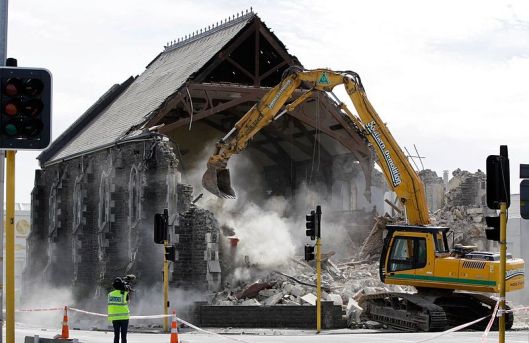
Something to Avoid: Churches can fall into a spiral now that results in the bulldozer later. (photo credit: Wikimedia Commons)

The Protestant religious landscape in my town is punctuated by two ongoing trends: new church plants bustling with young families and established congregations that are plateaued or in decline. The newer churches almost all uphold traditional church teachings, but utilize non-traditional buildings for worship and meet at non-traditional times. Some, but not all, of the plateaued or declining churches are more liberal in their theology. Regardless of if they are traditionalist or revisionist, these older churches are leasing their church buildings to pre-schools and other non-church groups and feature graying congregations.

With this backdrop from my local community in mind, Associated Baptist Press caught my attention this week with a story about a church in Decatur, Georgia which is about to be shuttered, demolished, and re-developed into a shopping center. Once drawing 500 persons on a Sunday, Scott Boulevard Baptist Church is now down to less than 50 members, most of which are rapidly aging.

Read the full story at www.VirtueOnline.org


Charges of TEC-Related Fraud and Bribery Filed Re: Election of Tanzanian Primate

The general synod of the Anglican Province of Tanzania held an election on Saturday to select a primate, and now a complaint has been filed with the provincial House of Bishops to suspend the results of the election pending an investigation into charges of fraud and bribery.

Elected by just three votes on the third ballot was Bishop Jacob Chimeledya, a graduate of Virginia Theological Seminary—but the total number of votes cast in the election was also three more than the number of clergy and laity present and voting.

The runner-up was the existing primate of Tanzania, Archbishop Valentino Mokiwa, who had been serving since 2007, and who was eligible for one more five-year term.

The complaint asks the House to annul the election, and to remove from their offices the synod’s General Secretary, Dr. Dickson Chilongani, and its Registrar, Prof. Palamagamba Kabudi. It alleges that the election had been rigged by means of “walking around” money to the tune of $50,000, spread among those who voted for +Chimeledya, and that the money came from a source within the Episcopal Church (USA).

However, supporters of Bishop Chimeledya have charged that it was Archbishop Mokiwa and his followers who used American money to try to influence the election. But if so, the attempt obviously failed—and the extra three votes remain unexplained.

The two factions differ sharply over the current stance of the Province toward the Episcopal Church (USA) and the Anglican Church of Canada.

In 2006, after ECUSA’s General Convention failed to make any meaningful response to the Windsor Report, the Tanzanian House of Bishops issued a statement condemning the stance of ECUSA, and declaring that its communion with that Church was “severely impaired.” At the same time, the House of Bishops declared that the Anglican Province of Tanzania would remain in communion with those in ECUSA (or those who had left) who are “faithful to Biblical Christianity and the authority of Scripture.”

Bishop Chimeledya and his followers do not support that position, and want to have Tanzania declare that it is once more in full communion with ECUSA and the ACoC. They also reportedly want to distance the Province from the Global South and GAFCON. That agenda is what makes the charges of bribery and fraud in the election so critical.

Ironically, in the same 2006 statement, the Tanzanian House of Bishops declared:
Further to the consequent state of the severely impaired communion, the House of Bishops of the Anglican Church of Tanzania declares that henceforth the Anglican Church of Tanzania shall not knowingly accept financial and material aid from Dioceses, parishes, Bishops, priests, individuals and institutions in the Episcopal Church (USA) that condone homosexual practice or bless same sex unions.
It will evidently take some time for the truth to emerge. When it does, there could be repercussions here in America.

ST. GEORGE, SC: Three more Parishes join Diocesan Lawsuit to Prevent TEC Seizure

ST. GEORGE, SC: Three more Parishes join Diocesan Lawsuit to Prevent Episcopal Church from Seizing Property

Amended complaint shows 34 congregations stand against TEC, adds Episcopal Church of South Carolina as defendant

News Release
February 28, 2013

Support increased again for the Diocese of South Carolina's fight to prevent The Episcopal Church (TEC) from hijacking more than $500 million in local property as three new parishes joined the suit, bringing the total number of congregations supporting the litigation to 34.

The amended complaint also added as a defendant The Episcopal Church in South Carolina, the name adopted by parishes that remain aligned with TEC, which previously had been the only defendant in the suit.

Read the full story at www.VirtueOnline.org

Justin Welby at Coventry Cathedral: The Crooked, Straight Path of Reconciliation

Here is Archbishop Welby’s address to the “Faith in Conflict” Conference at Coventry this week.
Notice, as you read, the assertions he makes, namely:

1. There is no mention false teaching and true teaching. Instead there is only “diversity” of belief
2. Diversity is a necessary and good thing in the “family” of the church…and everyone in the church (visible) is, apparently, part of the family.
3. The refusal to accept diversity and the conflict that attends to it is a “circle the wagons approach” that is born of “fear.”
4. Reconciliation involves conflict…but the struggle must be aimed toward remaining unified.
The New Testament truth that those who promote false teaching are not “members of the family” but like wolves in the midst of the flock is wholly absent.

The Crooked, Straight Path of Reconciliation
Ruth 1:15-18 Luke 10:29-37
It is a pleasure beyond description to be back in this wonderful Cathedral where I have fallen asleep so often. The worst time was when leading Evensong, which is very visible. I slipped over sideways, and woke as the Magnificat ended. As I woke I wondered if I could pretend that this was merely an unusual position for prayer, but the stifled laughter by the verger soon stopped any pretence.
As usual each time I come in, the breath-taking and austere beauty of structure ruined and rebuilt catches my imagination afresh. In the golden anniversary service last year Rowan Williams preached memorably on the concrete text around us. And yet there is an irony, for the symbol stands as one of the greatest Cathedrals an age for Christian churches that appears too often to think the words “Father forgive” are mere formality. In blunt terms, we have this conference because conflict is so much part of our lives.
That is all wrong. I do not mean that conflict is wrong, but that our fear of it, our sense of it being wasted time and effort, is wrong. So often we seek like mindedness so that we can get on with the job of worship, of making disciples, of serving other human beings. Because conflict in the church is time consuming and destructive, we turn from facing it and instead seek those with whom we agree.
In Indiana there is a town called New Harmony. It is the rebuilt Harmony, which fell into disrepair when the original Harmonists fell out and left. It is the spirit of much Christianity: make a new frontier when things don’t work out with everyone, move on with those who agree - and again and again.
Conflict arises from the diversity in which we have been created. When we seek to find a way of life that avoids it we deny the three realities of our fallenness, our present diversity, and the tension between the realised present and anticipated salvation of our futures.
Reality is lived as part of a people united by the fact that they call on God. Ruth and Naomi were exiles, first one then the other, economic migrants whose suffering is matched by many of those who seek new lives today. Caught up in famine and war, families destroyed by disease, they come to a cross roads. Ruth’s unity with Naomi is established by the words “your God will be my God”.
From that moment on, a moment of choice in love, responding to love, they are one far more deeply than as family in Moab.
That is passive unity, being part of the one family. But when we call on God he “calls us to his side as heralds of reconciliation”[1]. There is active co-operation with the life of God in our lives now. We live and we serve. The recognition by the Samaritan of the other as his neighbour leads to action, not mere existence. He becomes a herald of reconciliation.
In the old expression, we can choose our friends but we are stuck with our family. And so, by calling on God we are bound into a fellowship of being heralds of the reconciliation we have received. We had better get used to it because it lasts for ever.
In 1980 and 1981 Caroline and I were involved in taking bibles to Eastern Europe, then under Communist and Soviet domination. The two trips we made were remarkable, because through them we met Christians of all denominations and all sorts and personalities. Very often we spoke neither their language nor shared their assumptions about the world. But we found ourselves amongst family. I still recall clearly an evening of total non-comprehension and profound fellowship on the sixth floor of a tower block with a woman and her friends who were working with youth in the local church. For this crime they were made to suffer. We feasted on family reunion as we responded to the Spirit of God in each of us.
Reconciliation is recognition of diversity and a transformation of destructive conflict to creativity. It holds the tensions and challenges of difference and confronts us with them, forcing us to a new way of life that accepts the power and depth and radicality of the work of the Holy Spirit in our conversions.
We speak often in foreign policy of failed states, or failing states. Their common characteristic is the inability to manage diversity and grow with it, enabling it to change them significantly into better places. The core of the American sense of exclusivism is often found within that vocation of being a diverse and thriving nation.
If the Church is not a place of reconciliation it is not merely hindering its mission and evangelism, appalling as such hindrance is, but it is a failing or failed church. It has ceased to be the miracle of diversity in unity, of the grace of God breaking down walls.
But how do we escape the reach of these demons? Because by the grace of God we are defined as family with a call to action in reconciliation, then we have to find not only the call but also the means of being reconcilers, when our instincts and passions often lead us in the opposite direction. Circling the wagons and self-defining as those who are of one mind against the rest of the world has a noble feeling. Hollywood inspired, it gives us the feeling that this is a good day to die hard - hard of heart and hard in action. By contrast the process of reconciliation seems weak and unprincipled, alienating us from everyone involved in quarrel. It is a real work of grace, with all the absence of gratitude for grace that God Himself has experienced. I find myself often doubting myself deeply: have I become totally woolly, taken in by the niceness of bad people, trapped in an endless quest for illusory peace rather than tough answers. That is a question that all involved in reconciliation should be asked, and held accountable to, but it is also part of the process. Bonhoeffer, reflecting on the Good Samaritan, speaks of “the crooked yet straight path of reconciliation”[2]. The Priest and the Levite travelled straight on, the Samaritan turned aside. His path to the neighbour was straight to God.
Grace filled reconciliation begins with hospitality. Hospitality is a many faceted virtue, which reflects the doctrine of Catholic social teaching of the universal destination of goods. Because God offers enough for all, in our compassion we share what we have received as stewards of a great gift. It is not a matter of calculation of potential return but of gratuity, of grace. “To understand another’s distress as one’s own is to recognise that other as a neighbour, whether they are family, a friend or a stranger”[3]. Grace is lived in lavish recognition of our common receiving. The Samaritan turns aside, recognises the stranger, tends and nurses him at risk and cost, and provides.
Reconciliation is painful; grace is something that is squeezed out of our mixed motives. A church with which I worked had come near to absolute division. The challenge was to find a means of speaking truth safely to each other. The vicar and those who opposed him were in many cases truly heroic in being willing to listen and willing to change. They saw the distress of the other, recognised the call of God and the demands of grace and responded. But it was neither quick, nor universal. Grace crept into the cracks of the church and began to heal them, and the space for grace was opened by their own knowledge of the love of God. Pope Benedict XVI wrote:
“Awareness of God’s undying love sustains us in our laborious and stimulating work for justice and the development of peoples, amid successes and failures, in the ceaseless pursuit of a just ordering of human affairs. God’s love calls us to move beyond the limited and the ephemeral, it gives us the courage to continue seeking and working for the benefit of all,”[4].
The failing church fails because it is not open to the love of God. Success has many faces, but all of them are rooted in finding the love of God at work in us and seeing it in others.
The complexities of grace are experienced not only in our inner resistance and desire to circle the wagons, but also in grace having to be expressed as we journey. The Samaritan moved on, and came back. His journey and business continued, and yet he found the crooked, straight path. Journeys are periods of changing context. For me the journey to parts of Africa, often made, is always a time of tension. The context will shift so rapidly between boarding the aircraft and arriving that I feel fear and weakness, not of what I will find but of the challenge of adapting. A South African Islamic scholar reflecting on the ways of understanding texts in times of oppression wrote,
“People’s lives are not shaped by a text as much as shaped by the context”[5]. The church is called to express reconciliation on the road together, in common journeying. We come to our texts, and find massive differences in understanding, but as the recent “Bible in the Life of the Church” report shows, context deeply affects how we understand. Ruth does not speak of understanding but of journey, “where you go, I will go; where you lodge, I will lodge; your people shall be my people and your God, my God.”
Accepting we belong to God together because of His action, determined to express the common gift of grace and the universal goodness of what we have received, we journey together with much difficulty. We are many tribes, but one people. For that to have any possibility of success the journeying must be in truth, responding to the Spirit of God in us calling to the Spirit of God in each other. In journeying we must speak to each other. Silence is not peace. The Quaker Faith and Practice[6] book says “by their silence the progress of world peace has stood still”, there is a need to name issues, to listen and to let go of fear. A German Quaker in 1958, speaking with the experience of a defeated and divided nation said “the secret lies in the way in which truth is spoken”[7].
But speaking is not endless discussion.
“Care for the sick and the poor, hospitality to strangers, educational initiatives and peace-making endeavours are all examples of ways in which the church hosts the life together of its neighbours and enables that life to bear witness to its eschatological possibilities”.[8]
We are in a very demanding common journey and fear is an ever present reality. Fear is the opposite of trust[9] and our context is one of fear, a context which infiltrates the church. We do not trust the sciences on earth science, or the politicians, or the journalists or the Bishops or the bankers. The absence of trust renders all decision making a matter of law and all laws an attempt to cover every possible contingency, a complete impossibility in a world of change and journey.
The possibilities open to a church of reconciled reconcilers are more than we can imagine.
Reconciliation touches every aspect of our lives and society, and every aspect of our creation and living in our world. We can be reconcilers of the environment and natural order, of families and communities, of economies and financial services, of families and nations. We will weather the issues of politics and flourish in the storms of societal change.
If we can name and listen, be in conflict but not destruction, take the crooked straight path of reconciliation, we can establish a pattern and model of trust filled living drawing on the grace of God, a model that changes the world. Captured by the grace of God the church has done it before, many times. Different yet feasting together we must be gluttons of the grace of God, like children at a grand birthday party sharing messily what we have been given. Gluttony and grace go together in worship to create trust, and the grace of the Eucharist is where we begin.

House of the walking dead going on retreat


House of Bishops to gather in retreat for prayer, reflection, discussion

[Episcopal Church Office of Public Affairs] Bishops of The Episcopal Church will gather for the House of Bishops spring retreat meeting March 8 – 12 at Kanuga Conference Center in NC.

The theme of the gathering will be Godly Leadership in the Midst of Loss. Meditations will be offered by various bishops on different aspects of loss. There will be daily meditations, reflection, daily worship and, at the concluding Eucharist, the bishops will renew their vows.

The bishops will gather for discussion on topics such as gun violence, and a business meeting will be held on March 12.

As in previous years, the spring meeting of the House of Bishops is a retreat and therefore not open to the media. Daily Accounts will be issued. There will be an over-the-phone media conference at the conclusion of the meeting on Tuesday, March 12. Pre-registration required; to register contact Neva Rae Fox, publicaffairs@episcopalchurch.org.

The Director of Reconciliation Illustrates the Mechanics of Collusion

An interview with Canon David Porter, ++Justin Welby’s new Director of Reconciliation for the Anglican Communion transcribed by one of the elves over at T19:
ES: But so I am clear returning to my question, the press release from Lambeth Palace says ‘his [that is your] focus will be on supporting creative ways of renewing conversations in relationships around deeply held differences within the Church of England and the Anglican Communion’
Porter: Well I think we recognise that if the church is going to make any constructive contribution to the conflicts that are going on in our world then we need to look to ourselves and we need to be a people who are on a journey of Reconciliation who are modelling, not necessarily that we agree because it doesn’t necessarily mean that we are all going to agree, but that we hold our differences in a very Christian and constructive way
ES: Well, doesn’t this put a huge burden on your shoulders because the truth is that these tensions within the Anglican Communion and the Church of England have as you have just reflected in a way, have arisen because of very deeply held theological doctrinal disputes about questions like women bishops, like homosexuality, and it is difficult to see how one man by focussing on ‘process’ can overcome those.
Porter: Well in one sense it isn’t my job to overcome those issues – there are plenty of more intelligent more creative people who have lived and journeyed with these issues for quite a number of years. My job is actually to look at ‘process’ – it is to look at how we create the space for conversations to take place where people will still differ and they still will disagree but they will do so in a way that is able to say ‘look this is how Christians disagree, this is how we hold tensions and differences together’
ES: Except that on some of these issues people will believe that the disagreements go to the very heart of what it means to be a Christian
Porter: that is true
ES: so how can, how can a better ‘process’ overcome that?
Porter: well, in my background in Northern Ireland I used to say to people that if you are a fundamentalist protestant who believes that the catholic church are not Christian or if you are a strong catholic who believes there is no salvation outside the church and you’re in that conversation, the reality is that Jesus still tells you to love the people that you perceive as your enemies and that shows that you are holding what you hold on to in a Christian way and are able to disagree within that commitment of Jesus teling us how we disagree
ES: Do you think that some senior members of the Anglican Communion have forgotten that basic fact in the way that they have conducted themselves in these debates?
Porter: I think all of us when we get caught up in conflicts that are deep to who we are and to the values that we hold on to – we do forget that bigger voice from God that calls us to a different way of engaging with difference…read the rest
You can listen to the entire interview here.
Can there be any doubt at all about Archbishop Welby’s intentions? Can there be any doubt about what he means by “reconciliation”? He means that even though those who promote non-celibate homosexual behavior in the church and those who uphold biblical sexual morality make mutually exclusive truth claims about the nature and content of the Christian faith, the Person of Christ, and the authority and truthfulness of the Word of God, can and even should still call one another “brother”, work together to promote “the gospel”, legitimize and promote one another’s ministry.

As I’ve said before, many times, to agree with him and participate in any such process of mutual ministry or legitimization or even to call one of these heretics “brother” is a betrayal of the gospel. It is to participate with the hellish work of leading souls away from Christ. St. Paul writes in 1 Cor 6:9 writes that those who live lives characterized by homosexuality (not talking about the repentant person who struggles and falls but who struggles against it) will not inherit the kingdom of heaven. The message received by people who struggle with homosexuality when they see false teachers like Bishop Johnston embraced by orthodox leaders is: “This an area over which good faithful Christians can differ. If I side with Johnston on this, I can still faithfully serve Jesus and consider myself a disciple.”

That is a lie that St. Paul says damns people.

Bishop Johnston is teaching soul destroying heresy.

To participate with Canon Porter and Archbishop Welby and reconcile with men like Bishop Johnston without first demanding repentance and recantation, is to favor the visible fellowship of clergy over the care and protection of souls…a form of prejudice made even more sickening when it is given the false name “unity” and described as “reconciliation” .

AND NOW…IDIOTS

With his usual class, Episcopalian priest Tom Ehrich weighs in on Benedict XVI:

I wish I could see Pope Benedict XVI’s surprise decision to resign on Feb. 28 as a mea culpa for having led the world’s largest Christian body backward for eight years.

And not into union with the Episcopalians which is where he should have led it.

Alas, he has made no apology for cementing Roman Catholicism’s reputation as male-centric, homophobic and uninterested in sex abuse scandals beyond their litigation costs.

coughBEDEPARRYcough.  Glass houses and all that, Ehrich.  But Tommy’s screed actually gets worse than this.

In an eerie tone-deafness, he announced his retirement in Latin and had it translated into seven languages of Europe, where the church is close to extinct, and not into any of the African, Asian or Middle Eastern languages spoken by emerging Catholics.

Way worse.

Rome’s obdurate stands against oppressed peoples are shameful. Its harsh treatment of women and gays are not only anachronistic but bad theology. Its institution-first responses to sex abuse by clergy are appalling.

“Obdurate stands against oppressed peoples.”  “Harsh treatment of women and gays.”  Yeah, Rome hates them oppressed people a whole bunch.  And it is, in fact, funny to read an Episcopalian using the term, “bad theology,” thanks for asking.

That is a sad legacy. The world has needed more. Not just the insular world of the Roman Catholic Church has needed more, but the world itself, for the pope is the public face of global Christianity. With its largest force stuck in the 19th century, providing safe cover for oppression and intolerance, Christianity has a reputation that smaller denominations and individual congregations struggle to escape.

Basically, Tom wants his doctor to tell him that the hacking cough Tom’s had every day for the last three months is nothing to worry about.

When young American adults are asked what “church” means to them, they answer with words like “harsh, judgmental, intolerant, angry, old and dull.”

Must be nice to attend a “church” without sinners.

I doubt anyone expects an eruption of progressivism in the upcoming papal election. But a sign of moving forward would be welcome to many Catholics — and more than a few non-Catholics. Those crying for kindness and tolerance, justice and courage, aren’t just a ragged bunch of malcontents or anti-Catholics.

Yes they are.

These are the faithful — not all of the faithful, of course, for faith comes in many forms, some of them quite conservative — but large cadres of 21st century believers yearning for a 21st century church that’s capable of hearing their needs and proclaiming a gospel set free from the reactionary attitudes of self-preservation.

Episcopalians in search of apostolic legitimacy, in other words.

How will Benedict be remembered? It’s hard to say. My guess: as a placeholder. He tried to turn the tide of history because he disagreed with that tide and found it theologically dangerous. I hope the next pope does what Jesus did: hearing the beggar’s cries, against his disciples’ wishes, inviting the beggar closer and then healing him.

In the world and of the world.  Certainly, Episcopalians are kicking ass and taking the names of empty pews with that approach.

Executive Council fails to fulfill the mind of General Convention

Executive Council fails to fulfill the mind of General Convention
Offers 37-page report why it can't comply

By Mary Ann Mueller
Special Correspondent
www.virtueonline.org
Feb. 27, 2012

LINTHICUM HEIGHTS, MARYLAND--The Episcopal Executive Council has turned its nose up and its thumbs down to moving Episcopal Church headquarters away from Manhattan Island in New York to less pricy real estate elsewhere. In so doing, it has failed to fulfill its own mission to carry out the mind of General Convention.

Title I Canon 4.1(a) states that the Executive Council duty is to "carry out the program and policies adopted by the General Convention. The Executive Council shall have charge of the coordination, development, and implementation of the ministry and mission of the Church."

The same canon also states in subsection (b) that Executive Council "shall be accountable to the General Convention and shall render a full published report concerning the work with which it is charged ..." The canon goes on to say that the report "shall also include information on the implementation of all concurred resolutions of the previous General Convention calling for action by the Executive Council ..."

Read the full story at www.VirtueOnline.org

Bonfire of the Vacuities: Selected Audio Clips from the Baucum/Johnston Interview

How bad is the interview of Tory Baucum and Shannon Johnston about their “reconciliation” with each other? Let us count the ways…
Here, Baucum reveals that he still believes he and Shannon Johnston are part of the same religion - one that simultaneously blesses gay unions as holy, and condemns them as sinful:
Popout
Here’s Baucum, explaining that we bottom-feeders of the blogosphere, who have never met him, are also incapable of nuanced discussion:
Popout
Johnston, explaining how our differences really aren’t that important:
Popout
Here’s more from Baucum about something called “relational orthodoxy,” complete with a sideways slam of us Americans:
Popout
Johnston, explaining that all that schism and litigation? Yeah, trivial compared to what binds us together:
Popout
Johnston, on making beautiful music with Baucum:
Popout
And on and on it goes. I can’t bear to post any more, but if you want to listen to the entire interview, it’s right here, and if you can’t bear to listen to it, the American Anglican Council has made a complete transcript available.

It's a schism, not a realigmnet


GREENSBORO, NC: AMIA Leader Notes Losses, Sees Hope in Formation of New Society

GREENSBORO, NC: AMIA Leader Notes Losses, Sees Hope in Formation of New Society
Bishop Murphy said two thirds of his parishes have fled to other jurisdictions

By David W. Virtue
www.virtueonline.org
February 27, 2013

In his final address to members of the Anglican Mission in America (AM), outgoing Bishop Chuck Murphy admitted that he has lost two thirds of his churches to other Anglican jurisdictions, but said the best still lies ahead for the Anglican Mission, now transitioned into a Society of Mission and Apostolic Works.

"This is the first winter conference since the great realignment and we are now the same size we were four years ago," he said.

Addressing several hundred followers in Greensboro, NC at their annual Winter Conference, Murphy noted that in the first eleven years, the Mission celebrated one new church plant every three weeks with a total of 268 churches. However, over the past eleven months, two-thirds (about 179 churches) had transferred into another expression of church life, he said.

Read the full story at www.VirtueOnline.org

Catholic Expert Details ‘Huge Homosexual Underground in the Church’

That there is a huge homosexual faction in the Roman Catholic Church - and that it’s well-organized and up to no good - is no secret, and there’s a debate to be had about how ‘underground’ it really is, but it’s encouraging to see the church continuing to confront it, and equally encouraging to see Catholic-friendly sites like LifeSiteNewscovering it. Longtime readers here at Stand Firm will also recognize this particular pattern:
They know well, however, that they may be exposed and embarrassed, so they shield one another by offering mutual support. They build informal relationships reminding of a clique or even mafia, aim at holding particularly those positions which offer power and money.
When they achieve a decision-making position, they try to promote and advance mostly those whose nature is similar to theirs, or at least who are known to be too weak to oppose them. This way, leading positions in the Church may be held by people suffering from deep internal wounds.
They may actually achieve a dominating position in many areas of church hierarchy, become a “backroom elite” which actually has tremendous power in deciding about important nominations and the whole life of the Church. Indeed, they may even prove to be too powerful for honest, well-meaning bishops.

Modesty, the forgotten virtue - Bruce Atkinson

Modesty, the forgotten virtue
A Christian psychologist's perspective

By Bruce Atkinson PhD
Special to Virtueonline
www.virtueonline.org
February 27, 2013

"And I want women to be modest in their appearance. They should wear decent and appropriate clothing and not draw attention to themselves by the way they fix their hair or by wearing gold or pearls or expensive clothes." (1 Timothy 2:9, NLT)

In the past, modesty was considered to be an important virtue. The term "modesty" has various dictionary meanings, the basic ones focusing on moderation and propriety in speech, dress, or behavior. In clothing and fashion it is about preventing exposure to the more private parts of the body. Synonyms for modesty include: reserve, decency, discretion, demureness, unobtrusiveness, inoffensiveness, propriety/ appropriateness, simplicity, unpretentiousness, mature taste, meekness, and humility. Antonyms include offensiveness to public moral values, vanity, indecency, showing off, ostentation, pretentiousness, inappropriateness, indiscretion, tastelessness, unseemliness, boldness, temerity, boastfulness, immaturity, and pride.

Read the full story at www.VirtueOnline.org

And another one bites the dust for pecusa


St. George's Spesutia, Maryland's oldest Episcopal parish ends worship services

St. George's Spesutia, Maryland's oldest Episcopal parish, to end worship services
Diocese cites declining attendance, financial and other concerns in decision

By Allan Vought,
http://www.baltimoresun.com
November 9, 2012

St. George's Spesutia Parish in Perryman, the oldest Episcopal parish in Maryland, will suspend holding worship services effective at the end of the year, the Bishop of Maryland has informed parishioners.

In a letter dated Nov. 1, the Right Rev. Eugene Taylor Sutton, explained the decision to members of the parish, which has been in continuous operation since 1671.

Sutton's letter, a copy of which was provided to The Aegis by a parishioner, cited a lack of attendance at Sunday worship services, a lack of income from the collection plate and pledges "to sustain a parish financially with your buildings and grounds, let alone to sustain a thriving ministry" and the likelihood that the parish's investments would be depleted within four years if the financial situation continued.

Read the full story at www.VirtueOnline.org

Another one down for pecusa


TOTOWA, NJ: Episcopal Church in Totowa closing after 91 years

TOTOWA, NJ: Episcopal Church in Totowa closing after 91 years

By Matther Kadosh, Staff Writer
PASSAIC VALLEY TODAY
www.northjersey.com
January 10, 2013

Borough resident Shirley Gerhardt, 88, remembers her early days at the Christ Episcopal Church on Totowa Road. She started going there as a teenager.

Church members sing hymns and the Rev. Mark Waldon leads a service on Sunday. It is the church's final service as they are closing after serving the community for 91 years.

"My father used to say I spent more time there than I spent at home because I used to do yard work in the garden, planted plants and all kinds of stuff, in addition to actually worshiping there," Gerhardt said.

Read the full story at www.VirtueOnline.org

Wednesday, February 27, 2013

Squaring the Circle: Fr. Matt might be right


A Prediction

The writing is on the wall I think. The Archbishop of Canterbury will link the ACNA’s communion recognition to the ACNA’s willingness to participate in his “reconciliation” process. “Reconcile with the Episcopal Church and you will be rewarded with a place at my table.”

The question, I think, will be whether or not the ACNA bishops possess the fidelity to refuse the lure and stand firm. I think they do and pray they will.

If they don’t - and this is predictive not a declaration - then the ACNA will begin to come undone.

Totally rediculous


The Baucum - Johnston Conversation. Baucum: Johnston is an Orthodox Brother

Anglican Mainstream has published what they report to be the public conversation between Tory Baucum and Shannon Johnston at the recent Faith in Conflict Conference that we’ve been writing a lot about lately. There’s so much here to respond to I think it’s worth taking the time to work through. Do forgive me for the longish post, I trust you’ll find it worthwhile.

Do please also note AM’s caveat at the start:
These do not claim to be verbatim notes – and should be checked against a recording. But they seek to give the flavour of the discussion that took place in Coventry Cathedral at the Faith in Conflict Conference on February 26 2013, chaired by Canon David Porter, Director of Reconciliation for the Archbishop of Canterbury and in the presence of the Archbishop and 200 plus participants.
Here we go.
William Marsh began by asking the two discussants to give some background.
Rev Tory Baucum explained that he became Rector of Truro Church in 2007. The church had already been engaged in a lawsuit over its property for eight months.  There were accumulated grievances between Truro and the Diocese of Virginia and the national church (TEC). In the past Truro had helped introduce the charismatic renewal to TEC.  It also had a strong missions involvement, for example with a 40 year long relationship with the Diocese of Kigezi in the Church of Uganda which helped shape its understanding of spirituality.
“The tipping point came in 2003 with the consecration of Gene Robinson as a bishop, a man in a sexual relationship with another man.  The Primates Meeting (of 2003) said that such a consecration would tear the Anglican Communion at its deepest level.  Anglicans especially from the Global South said it was a schismatic act, which I think it was.  This led Truro Church to align itself with another part of the Anglican Communion. This was the setting in which I came into Truro.
Bishop Shannon Johnston:  I was elected Bishop coadjutor, with the right of succession in January 2007 and consecrated in May 2007.  I do not know what it was like to be a bishop without legal issues around. I became the diocesan bishop in 2009.  Truro was one of the fifteen lawsuits in progress when I became bishop. I agree that the tipping point was the election and consecration of a gay man in a committed monogamous relationship. This became the tipping point for the churches that decided to withdraw from the diocese.
Virginia is the largest diocese in TEC on the mainland of the USA.  It is an iconic diocese with the oldest Anglican churches – for example Jamestown in 1607.  It has many of the oldest congregations.  It has many iconic churches in an iconic diocese. It was involved in the same conflict that was taking part in different parts of the USA.
WM: What happens then?
TB:  The battle was protracted.  A lot of lifelong friendships have been broken. There have been battles over custody of the property. Personal life and ecclesial life has been affected.
SJ The relational side affected me more than the legal side.  The relational side is where I put my focus.
And here, friends, you see how Johnston is going to play this whole thing - he’s so hurt by the whole thing, so saddened by how relationships, which he focusses on, have been broken. This, also, will now become the thrust - restored relationships. Let’s see how it plays out.
WM.  So you are both in post and inherited litigation.
TB.  We met two years ago in 2011.  I had been wanting to meet Shannon.  We had been in a lawsuit at war. I had asked a predecessor of mine at Truro, Bishop John Howe to reach out to Shannon.  I went to Richmond to meet him.
The lawsuit was the occasion not the reason. I had been the rector for three years.  I had seen a reluctance in the church to reach out to different communities in our area.  There was fear.  I could not just tell people to reach out to people and places they were afraid of without setting an example. I wanted to reach out to an adversary.  We read that perfect love casts out fear, but equally perfect fear casts out love.
SJ.  My interest was in the relationships – I love to listen.  I was intrigued by the call that came out of the blue.  I was delighted Tory could come to sit down in the office so we could sit down to talk.  I was not sure what we would be talk about.  I felt there was a leading of the Spirit in this.  This caught me off guard. My sense would be to be defensive.  I was surrounded by something that felt godly from the beginning.
Here we see something that ought to be very concerning - both sides confirm that it was Baucum who initiated this process. Baucum, the rector of a church which had left the diocese because of heresy (for what other reason is there for such a dramatic action?) was actually the one who reached out to Johnston to establish a relationship of Christian fellowship.
The meetings were initially tense. But we ended with prayer.  And we asked why do we not meet each month.
WM Did people know you were meeting?
TB The meetings were private.  We considered that space to be safe.  Truro Vestry knew that I was meeting.  We kept it closed to protect it.
Truro Church has not been afraid to take a stand if it is a real matter of truth and justice.  Deep in the soul of the parish is the desire for peacemaking.
To give an example: the Chapel of Virginia Theological Seminary burnt down.  The Vestry decided to give significant sum of money to rebuild the chapel in our former diocese.
After the second ruling came which we lost, we called a special prayer meeting.  500 members gathered to pray.  A reporter who came said “I do not believe this. There is no anger but a sweet spirit.”
SJ My chief of staff, a practicing attorney was nervous about what the bishop might say. There were misgivings about a meeting behind closed doors and with no reports.  There was a fear of the unknown.  As the meetings went on they began to give it more space.  He began to see some change in me in relation to my ministry as a bishop from the time I began to meet with Tory. I had more of a sense of confidence.
BM Did this enhance you?
SJ.  I grew through this friendship.
TB This path changes you.
Well (and there’s simply no way to put this nicely) that is quite clear. This has changed Baucum. But it might be more accurate to say that it has taken him further along a road that he himself started walking on. There’s a clear sense of irony here, given his sermon that I commented on last year. For now let me just remind you of the text that was preached on there…
Psalm 1:1 Blessed is the man who does not walk in the counsel of the wicked…
now, back to the conversation…
WM What else developed?  What else progressed?
TB. God was with us.  There were always three present in our meetings.  Trust had been destroyed in this process.  The pathway to trust is transparency.  We would not paper over our differences nor would we exaggerate them.
I would not exaggerate them to say there were two different religions.  This has caused great disruption in a church which we loved.  We were doing this for the sake of the communities we were called to pastor.
I hope you all see why this is so very troubling. Baucum insists that he and Johnston do not have 2 different religions. And so here is the very heart of the problem he has now brought upon Truro. If they are still following the same one Christian faith then it was simply scandalous for Truro to part company with the diocese over what would have to be regarded as a second-order issue. He’s basically declared that there was no reason to make such a massive move. As I’ve said before, it utterly undermines not simply his own parish’s decisions but in reality the entire raison d’etre of the ACNA.
SJ Our prayers grew in scope and depth. I began to think something was opening up.  Our conversations were going to places we did not think they would go.  We talked about ordinary and personal things, theology and personal things.  Things opened up more and that set the stage for the next step.  It has always been we take a step into the unknown – we do not know why. Trust has been the great virtue.  Trusting God’s presence among us.  What do we see new? That new thing we see calls us to take another step.  We do not have much knowledge about where this is leading,
WM: What has been the impact on you of those who disagree with what you are doing?
TB It is painful and unfair. A lot of people who write about this have been wounded and betrayed.  They ask “Please do not let Tory betray us”. I have had those experiences myself.  I did not become the Rector of Truro to fight the Episcopal Church. I do not preach against TEC.  I still love TEC.  I consider Shannon a friend and a brother who has taken a wrong turn. This is not the same thing as not being a Christian.
He does worship the same resurrected Christ, he believes the same Nicene Faith. These are not nothing.  Those conversations do not happen on the blog.  By persevering over time – if this is godly and right God will vindicate it in time.
WM A brother who has taken a wrong turn.  Is one mutually exclusive of the other?
TB Augustine in discussion with the Donatists refers to his interlocutor as a brother.  One can be in serious error and be a brother.  The patron of a divided church is St Francis de Sales.  He did not convert the Protestants in Geneva back to the Catholic church. He decided to assault Geneva with love.  He only cited the authorities they could both accept.  This was relational orthodoxy. It does matter how we talk with one another. Even if someone is not in your view a brother, he is still made in the image of God. I do not feel lonely in terms of the great cloud of witnesses.
And here is the heart of Baucum’s betrayal (and that is what it is, despite his protestations). He declares that Johnston is to be regarded as orthodox. But there is more here. Let me outline just a few of many observations that could be made at this point:
  1. When Baucum says he does not preach against TEC there is something deficient and inappropriate given his position as Rector of a church that left TEC over heresy. While it ought not to define his ministry, he ought to be very aware of the issues that led to the departure and, of course, the duty of every minister is to not only speak positively of the gospel but also speak against error.
  2. Johnston’s serious error is so serious that it leads people straight to Hell - by affirming as godly that which the Scriptures say leads to damnation. With that in mind, part of his conversation with Johnston ought to have been to reiterate how terrible Johnston’s position was. Can you imagine a shepherd meeting up with the wolves and saying that it was acceptable since the wolves were only in serious error and had simply taken a wrong turn?
  3. Baucum’s appeal to Augustine is at best misguided. Yes, Augustine refers to the Donatists as “brothers” but consider how he does so (the citation here is from “Against the Donatists I.2
    For if the horse and mule, which have no understanding, resist with all the force of bites and kicks the efforts of the men who treat their wounds in order to cure them; and yet the men, though they are often exposed to danger from their teeth and heels, and sometimes meet with actual hurt, nevertheless do not desert them till they restore them to health through the pain and annoyance which the healing process gives—how much more should man refuse to desert his fellow-man, or brother to desert his brother, lest he should perish everlastingly…
    It’s quite clear that Augustine may use the term “brother” but he also states clearly that his idea of reconciliation with the Donatist “brothers” is that they repent lest they suffer everlasting damnation. I think it’s also clear that this is not the nature of Baucum’s conversation with Johnston.
  4. The appeal to De Sales is also misguided. The debates between the Reformers and Rome were full of citations from the Early Fathers but the point was that both sides wanted to make the argument that they were the true inheritors of those Fathers’  theologies. It wasn’t an attempt to affirm a common ground but a clear statement that the other had no genuine legitimacy. That was the preceding context for De Sales. He did not try to undermine that context or contradict what had been said before by Rome about the legitimacy of Reformed leaders or of Reformed doctrine. By contrast, Baucum’s words and actions serve to legitimize Bishop Johnston as a Faithful if mistaken Christian leader and disciple.
SJ I hold the same tension about agreeing and disagreeing. I am concerned about the way our position in TEC has been characterised.  Agreement is overrated.  What I am trying to do is stay in there and reclaim the best charism of Anglicanism – a ‘both-and’ quality. Looking back to the Elizabethan settlement. I am committed to being able to say that we do not paper over our differences.
WM How has your thinking about unity changed?
SJ I was a Music major and so I take an illustration from Music.  Leonard Bernstein is a favourite conductor of mine. In 1962 he conducted a concert of Brahms second piano concerto.  Bernstein said he disagreed with the pianist’s conception of the concerto.  Bernstein decided still to conduct the performance because of the integrity of the pianist.  They both disagreed with each other’s view of the score.  We make the music the gospel makes even when we find there are points of disagreement.
But consider 2 things here. First, briefly, this is not an appeal to Scripture as an argument. There is, tellingly, no appeal to scripture by either man anywhere in this interview (at least according to these notes). There can’t be since what is taking place between them is biblically indefensible. Second, what actually occurs in Johnston’s illustration is that the conductor submits himself to the pianist’s position. They may have disagreed with each other but there was no actual compromise. It may have been “unity” but one side had to capitulate his position to the others. And, of course, this is exactly what Baucum has done - he has capitulated to Johnston’s claim that TEC and the bishop of Virginia remains orthodox. Johnston has given up nothing in this whole “discussion”.
WM: What is the price you have chosen to pay?
TB So many of our sisters and brothers around the world have truly suffered for the faith. My experience has been most intense.  I have to say that it has not been worth it so far.  But I am living in hope.  I have a deep confidence that God has called us.  I am looking to see what God is going is to do. I come from a place where Jazz is the music. In Jazz there is no such thing as a bad note but there are no bad resolutions.
SJ We have come to know each other.  There is an incredible role of leadership in spirituality.  Some of Elizabeth’s (Mrs Baucum) comments been very influential.
WM: What are the challenges to being leaders in this context.
SJ How could I have a relationship with a church that had pulled out of the diocese?  They sense less than a steady hand on the wheel. I have received more affirmation than criticism.  Agreement is overrated. It has been very rewarding,  Many people have come out of the shadows.  Though it was right that the diocese should retain the property, they felt that the way we had been going through this divide has not felt right.  The way in which this was unfolding did not work for me. Something between Tory and myself enabled them to come to a better space.
Again, see how Johnston has won the argument here. “Agreement is overrated”. They are now both living into the tension of mutually contradictory positions being both affirmed. Please note, once more, Johnston has not had to move an inch, but Baucum has walked a long way down that Psalm 1:1 road.
Questions:
Q You both seem to be kind and generous and nice people.  How might it be possible to repeat the interaction you have had you have had among people who are not that nice?
What, like among the Stand Firm bloggers? wink
TB The quality of friendship is a common heart.  Can this be replicated?  What can be replicated is desire not to live in fear.  They are a son and daughter of God.  The other issues are not defining realities. If you start there and reach out there is no telling what might happen.  There are some principles we can learn – things we are not doing.
I can’t believe I’m reading this. “The other issues are not defining realities”. Think that through. The fact that Johnston is saying that sin is godly, that the word of God is not true, is not a defining reality alongside the fact that he is a son of God. But while you’re trying hard not to choke on your drink, can I advise you actually put your cup firmly on the table because the next sentence is shocking.
In living into this conflict we are living into the mystery of Christ.  It is not a problem to get around so that we can get on and do the real gospel thing.
And there it is. In black and white. “In living into this conflict…”.
Yes my friends, Baucum just read straight out of the Griswold playbook, from Schori’s deep scripts of profundity.
IN LIVING INTO THIS CONFLICT…
SJ How much of what we share is based on our individual temperaments? The substance is allowed for by our temperaments.  The methodology can be adapted to any sort of temperament.  Reconciliation is the gospel. It is a commitment to be who you are, if the other person can feel the authenticity.
Q.  Can you see the change cascading down?
TB   At Truro we have more seekers in the Alpha Course.
SJ Other voices have got involved other than the lawyers. I want to cleanse the wound. God is involved in this so I trust that God has all of this going on at the same time. I do believe that the Holy Spirit has all of this going on at the same time.
WM Do you not think Shannon should repent?
TB Yes. How does one repent? The kindness of God leads to repentance not the wrath of man.  My tribe have been wrong about a lot of things.  The Episcopal Church stood up for civil rights in Mississipi, not the Evangelical Protestants.
And here is the utter incongruity of the whole process. Yes, says Baucum, Shannon should repent. And yet he is happy to affirm him as a senior pastor in the church. Presumably since this is “not a defining reality”.
My history causes me to be humble. I want to hear how he has come to this place. This is not just about two individuals. We are pastors of a church.  It is about how we disagree and make decisions about differences.  This is different from two individuals who have a disagreement.
SJ The church is always going to have disagreements.  We have not handled this disagreement well. We have made it more destructive than it needed to be.
Let’s be perfectly clear about this travesty. If one thing has made this whole saga more destructive than it needed to be it has been Baucum’s actions. Let me say it again, he has utterly undermined the raison d’etre of the ACNA. But more than that, he is now a danger to the church of God if he insists upon affirming a heretic and a wolf of the worst sort: a man that willingly and wilfully encourages people into activity that will result in their damnation and that is why we at Stand Firm will not leave this matter alone. It is, quite simply, the largest crisis that faces Anglicanism in North America at this current time and it will only get worse since the implications go far beyond ACNA.

Don’t ever forget, this is the example of reconciliation that Justin Welby, the Archbishop of Canterbury, is holding up as a model for the healing of the Communion. What it essentially means is that no push to discipline to TEC is likely to come from Lambeth Palace. It saddens me to write that and I still pray that it will not be the case but there it is. So many of you reading this left TEC because it was “living into” some pretty horrific tensions only now to discover that ACNA is also now “living into” them too and so that’s why we will continue to bring it to your attention. There is too much at stake.

Mere disagreements?


A Conversation between Rector of Truro Church (ACNA) and the Bishop of the Episcopal Diocese of Virginia

UPDATE: Click here for the live recording of the interview.

Notes of the Interview by William Marsh with Rev Tory Baucum, Rector of Truro Church, Fairfax, Virginia, part of the Anglican Church of North America and Bishop Shannon Johnston, Bishop of the Episcopal Diocese of Virginia.

These do not claim to be verbatim notes – and should be checked against a recording. But they seek to give the flavour of the discussion that took place in Coventry Cathedral at the Faith in Conflict Conference on February 26 2013, chaired by Canon David Porter, Director of Reconciliation for the Archbishop of Canterbury and in the presence of the Archbishop and 200 plus participants. 

William Marsh interviews the Rev'd Dr. Tory Baucum and the Rt. Rev'd Shannon Johnson, February 26, 2013.

William Marsh began by asking the two discussants to give some background.

Rev Tory Baucum explained that he became Rector of Truro Church in 2007. The church had already been engaged in a lawsuit over its property for eight months. There were accumulated grievances between Truro and the Diocese of Virginia and the national church (TEC). In the past Truro had helped introduce the charismatic renewal to TEC. It also had a strong missions involvement, for example with a 40 year long relationship with the Diocese of Kigezi in the Church of Uganda which helped shape its understanding of spirituality.

“The tipping point came in 2003 with the consecration of Gene Robinson as a bishop, a man in a sexual relationship with another man. The Primates Meeting (of 2003) said that such a consecration would tear the Anglican Communion at its deepest level. Anglicans especially from the Global South said it was a schismatic act, which I think it was. This led Truro Church to align itself with another part of the Anglican Communion. This was the setting in which I came into Truro.

Bishop Shannon Johnston: I was elected Bishop coadjutor, with the right of succession in January 2007 and consecrated in May 2007. I do not know what it was like to be a bishop without legal issues around. I became the diocesan bishop in 2009. Truro was one of the fifteen lawsuits in progress when I became bishop. I agree that the tipping point was the election and consecration of a gay man in a committed monogamous relationship. This became the tipping point for the churches that decided to withdraw from the diocese.

Virginia is the largest diocese in TEC on the mainland of the USA. It is an iconic diocese with the oldest Anglican churches – for example Jamestown in 1607. It has many of the oldest congregations. It has many iconic churches in an iconic diocese. It was involved in the same conflict that was taking part in different parts of the USA.

WM: What happens then?

TB: The battle was protracted. A lot of lifelong friendships have been broken. There have been battles over custody of the property. Personal life and ecclesial life has been affected.

SJ The relational side affected me more than the legal side. The relational side is where I put my focus.

WM. So you are both in post and inherited litigation.

TB. We met two years ago in 2011. I had been wanting to meet Shannon. We had been in a lawsuit at war. I had asked a predecessor of mine at Truro, Bishop John Howe to reach out to Shannon. I went to Richmond to meet him.

The lawsuit was the occasion not the reason. I had been the rector for three years. I had seen a reluctance in the church to reach out to different communities in our area. There was fear. I could not just tell people to reach out to people and places they were afraid of without setting an example. I wanted to reach out to an adversary. We read that perfect love casts out fear, but equally perfect fear casts out love.

SJ. My interest was in the relationships – I love to listen. I was intrigued by the call that came out of the blue. I was delighted Tory could come to sit down in the office so we could sit down to talk. I was not sure what we would be talk about. I felt there was a leading of the Spirit in this. This caught me off guard. My sense would be to be defensive. I was surrounded by something that felt godly from the beginning.

The meetings were initially tense. But we ended with prayer. And we asked why do we not meet each month.

WM Did people know you were meeting?

TB The meetings were private. We considered that space to be safe. Truro Vestry knew that I was meeting. We kept it closed to protect it.

Truro Church has not been afraid to take a stand if it is a real matter of truth and justice. Deep in the soul of the parish is the desire for peacemaking.

To give an example: the Chapel of Virginia Theological Seminary burnt down. The Vestry decided to give significant sum of money to rebuild the chapel in our former diocese.

After the second ruling came which we lost, we called a special prayer meeting. 500 members gathered to pray. A reporter who came said “I do not believe this. There is no anger but a sweet spirit.”

SJ My chief of staff, a practicing attorney was nervous about what the bishop might say. There were misgivings about a meeting behind closed doors and with no reports. There was a fear of the unknown. As the meetings went on they began to give it more space. He began to see some change in me in relation to my ministry as a bishop from the time I began to meet with Tory. I had more of a sense of confidence.

BM Did this enhance you?

SJ. I grew through this friendship.

TB This path changes you.

WM What else developed? What else progressed?

TB. God was with us. There were always three present in our meetings. Trust had been destroyed in this process. The pathway to trust is transparency. We would not paper over our differences nor would we exaggerate them.

I would not exaggerate them to say there were two different religions. This has caused great disruption in a church which we loved. We were doing this for the sake of the communities we were called to pastor.

SJ Our prayers grew in scope and depth. I began to think something was opening up. Our conversations were going to places we did not think they would go. We talked about ordinary and personal things, theology and personal things. Things opened up more and that set the stage for the next step. It has always been we take a step into the unknown – we do not know why. Trust has been the great virtue. Trusting God’s presence among us. What do we see new? That new thing we see calls us to take another step. We do not have much knowledge about where this is leading,

WM: What has been the impact on you of those who disagree with what you are doing?

TB It is painful and unfair. A lot of people who write about this have been wounded and betrayed. They ask “Please do not let Tory betray us”. I have had those experiences myself. I did not become the Rector of Truro to fight the Episcopal Church. I do not preach against TEC. I still love TEC. I consider Shannon a friend and a brother who has taken a wrong turn. This is not the same thing as not being a Christian.

He does worship the same resurrected Christ, he believes the same Nicene Faith. These are not nothing. Those conversations do not happen on the blog. By persevering over time – if this is godly and right God will vindicate it in time.

WM A brother who has taken a wrong turn. Is one mutually exclusive of the other?

TB Augustine in discussion with the Donatists refers to his interlocutor as a brother. One can be in serious error and be a brother. The patron of a divided church is St Francis de Sales. He did not convert the Protestants in Geneva back to the Catholic church. He decided to assault Geneva with love. He only cited the authorities they could both accept. This was relational orthodoxy. It does matter how we talk with one another. Even if someone is not in your view a brother, he is still made in the image of God. I do not feel lonely in terms of the great cloud of witnesses.

SJ I hold the same tension about agreeing and disagreeing. I am concerned about the way our position in TEC has been characterised. Agreement is overrated. What I am trying to do is stay in there and reclaim the best charism of Anglicanism – a ‘both-and’ quality. Looking back to the Elizabethan settlement. I am committed to being able to say that we do not paper over our differences.

WM How has your thinking about unity changed?

SJ I was a Music major and so I take an illustration from Music. Leonard Bernstein is a favourite conductor of mine. In 1962 he conducted a concert of Brahms second piano concerto. Bernstein said he disagreed with the pianist’s conception of the concerto. Bernstein decided still to conduct the performance because of the integrity of the pianist. They both disagreed with each other’s view of the score. We make the music the gospel makes even when we find there are points of disagreement.

WM: What is the price you have chosen to pay?

TB So many of our sisters and brothers around the world have truly suffered for the faith. My experience has been most intense. I have to say that it has not been worth it so far. But I am living in hope. I have a deep confidence that God has called us. I am looking to see what God is going is to do. I come from a place where Jazz is the music. In Jazz there is no such thing as a bad note but there are no bad resolutions.

SJ We have come to know each other. There is an incredible role of leadership in spirituality. Some of Elizabeth’s (Mrs Baucum) comments been very influential.

WM: What are the challenges to being leaders in this context.

SJ How could I have a relationship with a church that had pulled out of the diocese? They sense less than a steady hand on the wheel. I have received more affirmation than criticism. Agreement is overrated. It has been very rewarding, Many people have come out of the shadows. Though it was right that the diocese should retain the property, they felt that the way we had been going through this divide has not felt right. The way in which this was unfolding did not work for me. Something between Tory and myself enabled them to come to a better space.

Questions:

Q You both seem to be kind and generous and nice people. How might it be possible to repeat the interaction you have had you have had among people who are not that nice?

TB The quality of friendship is a common heart. Can this be replicated? What can be replicated is desire not to live in fear. They are a son and daughter of God. The other issues are not defining realities. If you start there and reach out there is no telling what might happen. There are some principles we can learn – things we are not doing.

In living into this conflict we are living into the mystery of Christ. It is not a problem to get around so that we can get on and do the real gospel thing.

SJ How much of what we share is based on our individual temperaments? The substance is allowed for by our temperaments. The methodology can be adapted to any sort of temperament. Reconciliation is the gospel. It is a commitment to be who you are, if the other person can feel the authenticity.

Q. Can you see the change cascading down?

TB At Truro we have more seekers in the Alpha Course.

SJ Other voices have got involved other than the lawyers. I want to cleanse the wound. God is involved in this so I trust that God has all of this going on at the same time. I do believe that the Holy Spirit has all of this going on at the same time.

WM Do you not think Shannon should repent?

TB Yes. How does one repent? The kindness of God leads to repentance not the wrath of man. My tribe have been wrong about a lot of things. The Episcopal Church stood up for civil rights in Mississipi, not the Evangelical Protestants.

My history causes me to be humble. I want to hear how he has come to this place. This is not just about two individuals. We are pastors of a church. It is about how we disagree and make decisions about differences. This is different from two individuals who have a disagreement.

SJ The church is always going to have disagreements. We have not handled this disagreement well. We have made it more destructive than it needed to be.