Have They Violated Title IV? Ten Brave Episcopal Clergy Defy ECUSA in Fort Worth Case
Yesterday, seven bishops of the Episcopal Church (USA) -- five active, and two resigned (retired) -- joined the three Episcopal priests in the Anglican Communion Institute in filing an amicus curiae ("friend of the court") brief in the Texas Supreme Court appeal brought by Bishop Jack L. Iker and his Episcopal Diocese of Fort Worth to overturn the summary judgment granted by the District Court in favor of ECUSA and its rump diocese and parishes. The arguments in the brief present a view directly contrary to the view expressed in the case by the Church's attorneys that ECUSA is "hierarchical."
[Side note: Despite all the magic hand-waving by ECUSA's Presiding Bishop and its General Convention, there is one and only one way to have a diocese become a member of the association of dioceses known as the Protestant Episcopal Church in the United States of America. That one way is spelled out, in very clear words, in Article V of ECUSA's Constitution, and it has not changed in over 200 years. The faux "Diocese of Fort Worth" is here so called (and also denominated with adjectives like "rump", "Potemkin", "ersatz", or similar words) because it has not gone through that constitutional procedure. Unless and until it does, it is not a genuine ECUSA diocese, no matter how many official pronouncements issue from no matter what quarter of the Church.End of side note.]
The bishops joining in the brief are +Benitez (resigned - Texas), +Howe (resigned - Central Florida), +Lambert (suffragan - Dallas), +Love (Albany), +MacPherson (Western Louisiana), +Martins (Springfield), and +Stanton (Dallas). The three priests are the Rev. Prof. Christopher Seitz, the Very Rev. Dr. Philip Turner III, and the Rev. Dr. Ephraim Radner.
Earlier, the merits brief filed with the Court by ECUSA's attorneys contained the following statement at pp. 24-25:
As every court in the nation that has addressed the question has concluded, The Episcopal Church is a hierarchical church [footnote omitted]. The undisputed evidence in this case confirms that conclusion. The Church’s governing documents clearly reflect the Church’s three-tier structure, with the General Convention at the top tier.The amicus brief just filed, on the other hand, states at p. 16:
In this dispute, both sides do in fact agree that there is no explicit language in The Episcopal Church’s governing constitution identifying in express legal terms of hierarchy or supremacy any central body or office allegedly superior to the diocesan bishop [footnote omitted]. Indeed, none of the following terms routinely used in legal documents to indicate hierarchical priority is found at all in The Episcopal Church constitution: “supreme”; “supremacy”; “highest”; “hierarchical”; “subordinate”; “sole”; “preempt”; and “final.”So how could all those courts trumpeted (in the omitted footnote) in ECUSA's brief have found that ECUSA was "hierarchical"? Simple.
ECUSA's attorneys are playing their usual game of "look over there while we hide the ball over here." All of the cases cited by ECUSA as making that finding were cases involving relationships between bishops/dioceses, on the one side, vs. clergy/parishes on the other.
But the Fort Worth case is not that case: it involves one bishop and his diocese against other dioceses and their bishops who have joined into an association. Bishop Iker and his diocese withdrew from the association, as was their constitutional right under the First Amendment's freedom of association. The other bishops and their dioceses have sued Bishop Iker and his diocese for all of the diocesan properties and bank accounts.
Since when does an association to which you belong have the right to claim all of your property if you decide to leave it? (Hint to ECUSA and its attorneys: the Dennis Canon, which the dioceses and bishops invoked with the Church in those "many cases" alluded to earlier, makes a claim only to parish property, and not to the property of a diocese as such. So your argument that dioceses have to surrender their property upon withdrawal is without precedent in Church history, and indeed is specifically contradicted by its history during the Civil War.)
For ECUSA and its attorneys, all they have to do is wave the magic word "hierarchical" about, and courts must allow their claims. That is why the amicus brief filed by some of its own clergy, which points out the Emperor's lack of clothes on this occasion, must be both an embarrassment, and also no small irritant. After all, if the "Church" is at the top of the "three-tiered hierarchy," why can't the "Church" keeps its bishops and clergy in line?
Well, could it?
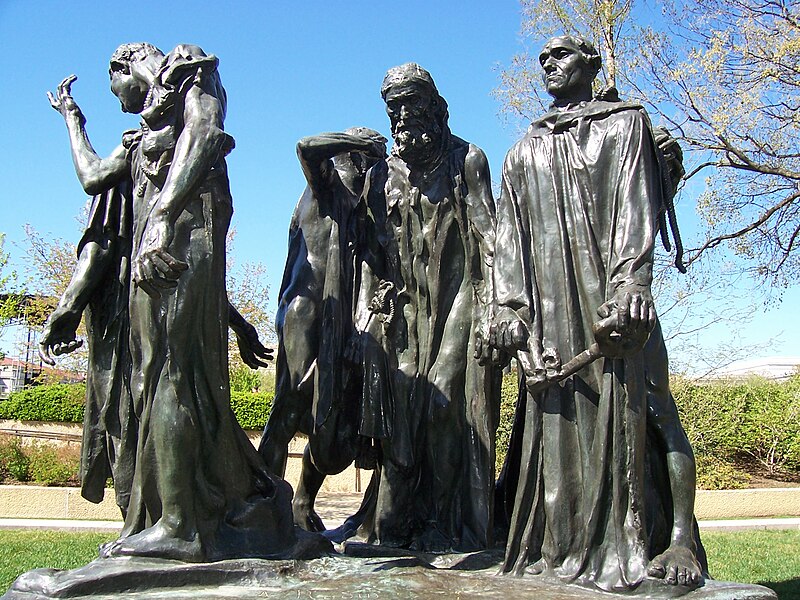
Could the leaders of ECUSA now lodge disciplinary charges under the new Title IV (that went into effect last July) against the seven bishops and three priests who have dared to defy them in open court, in an act no less brave than that of the Burghers of Calais? Let's go be a fly on the wall at 815, and see:
Scene: in a conference room in the chambers of the Presiding Bishop at 815 Second Avenue, New York City. Huddled together at a table are the Presiding Bishop, her Chancellor, and her Special Presidential Assistant for Litigation.
CHANCELLOR: The offenses for which a bishop or clergy may be charged under new Canon IV.3 include "knowingly violating or attempting to violate, directly or through the acts of another person, the Constitution or Canons of the Church or of any Diocese. . . ." The problem is that there is no Constitutional or canonical provision I can find in the entire Church which says that you cannot file briefs as a friend of the court. So, Mary, what else might we try?
SPECIAL ASSISTANT FOR LITIGATION: Well, under new Canon IV.4, all clergy in the Church must abide by certain "standards of conduct," such as these:
(b) conform to the Rubrics of the Book of Common Prayer; (c) abide by the promises and vows made when ordained;PRESIDING BISHOP: The BCP says nothing about amicus briefs, and I'm pretty sure the ordination vows don't, either. Couldn't I simply issue these meddlesome priests a Pastoral Directive to stay out of the Fort Worth proceedings? Then we could charge them with insubordination.
SPECIAL ASSISTANT FOR LITIGATION: But you would have had to issue the Directive before they filed the brief. I'm afraid we forgot to include any authority to issue Pastoral Directives on an ex post facto basis.
CHANCELLOR: Mary, dammit, make a note of that for the next GC.
SPECIAL ASSISTANT FOR LITIGATION: What about the requirement in subsection (e) to "safeguard the property and funds of the Church and Community"? Surely what they've done fails to safeguard our right to +Iker's property.
CHANCELLOR: They would simply argue that that's the very question involved in the Fort Worth case, and that until the Court decides it, we won't know whether it's our property or not. Besides, we're saving the first case under that section for Bishop Lawrence, as you know. We can't risk establishing a bad precedent with others first.
PRESIDING BISHOP: Wait -- there's this: it says in (h)(2) that all clergy in the Church must refrain from "holding and teaching publicly or privately, and advisedly, any Doctrine contrary to that held by the Church...". Couldn't we pretend, David, that whatever you write in any of our briefs in these cases was Church doctrine?
CHANCELLOR: Nice try, Bishop Katharine, but that canon has "Doctrine" with a capital "D". And that's a term defined in Canon IV.2 [reads]:
Doctrine shall mean the basic and essential teachings of the Church and is to be found in the Canon of Holy Scripture as understood in the Apostles and Nicene Creeds and in the sacramental rites, the Ordinal and Catechism of the Book of Common Prayer.PRESIDING BISHOP: Not a great loss, I guess. I don't really put much stock in that Canon anyway, since the trial of Bishop Righter.
CHANCELLOR [beneath his breath]: So some have observed.
PRESIDING BISHOP [sharply looking at the Chancellor]: What's that you say?
CHANCELLOR: Nothing. I just said that was an astute observation. [Pauses.] It looks to me, Mary, as though we've got only one charge left.
SPECIAL ASSISTANT FOR LITIGATION: You mean, the "catch-all"?
CHANCELLOR: The very one. [In a mockingly spectral voice:] Conduct Unbecoming a Member of the Clergy.
PRESIDING BISHOP: But hasn't that got its own special definition, too? Seems to me I remember something about dear old "Chuckles" Bennison...
SPECIAL ASSISTANT FOR LITIGATION: You are right, Your Grace. The term is defined as [reads]:
... any disorder or neglect that prejudices the reputation, good order and discipline of the Church, or any conduct of a nature to bring material discredit upon the Church or the Holy Orders conferred by the Church.PRESIDING BISHOP: Well, there we have it, then -- I can charge them with "conduct unbecoming a member of the clergy." Mary, you draw up the charges, and run them by David before bringing them to me to sign.
SPECIAL ASSISTANT FOR LITIGATION: But what's the specific violation?
PRESIDING BISHOP: Don't you see? They have written words to say that we are not "hierarchical" -- and not only that, they had the nerve to file them in a court proceeding adverse to us. They accused us, in essence of not speaking the truth. That is certainly intended to bring discredit on us.
SPECIAL ASSISTANT FOR LITIGATION: But won't they just respond that they were the ones speaking the truth?
PRESIDING BISHOP: What's wrong with you, Mary? Have you forgotten what it says in John 18:38? [Reads:] "Pilate asked: what is truth?"
SPECIAL ASSISTANT FOR LITIGATION: But didn't Pilate say that in response to Jesus's statement that he came to testify to the truth?
PRESIDING BISHOP: Exactly, Mary -- good for you. If Jesus Christ could get into trouble for speaking the truth in a court of law, then so can these infernal bishops. Now, draw up the charges!
[Scene darkens as a fly is heard buzzing in the background.]

No comments:
Post a Comment